Taking It Personally
I am very thin skinned. Not literally, I don’t think. I haven’t had it measured. But emotionally, I appear to have arrived without the extra layer everyone else got.
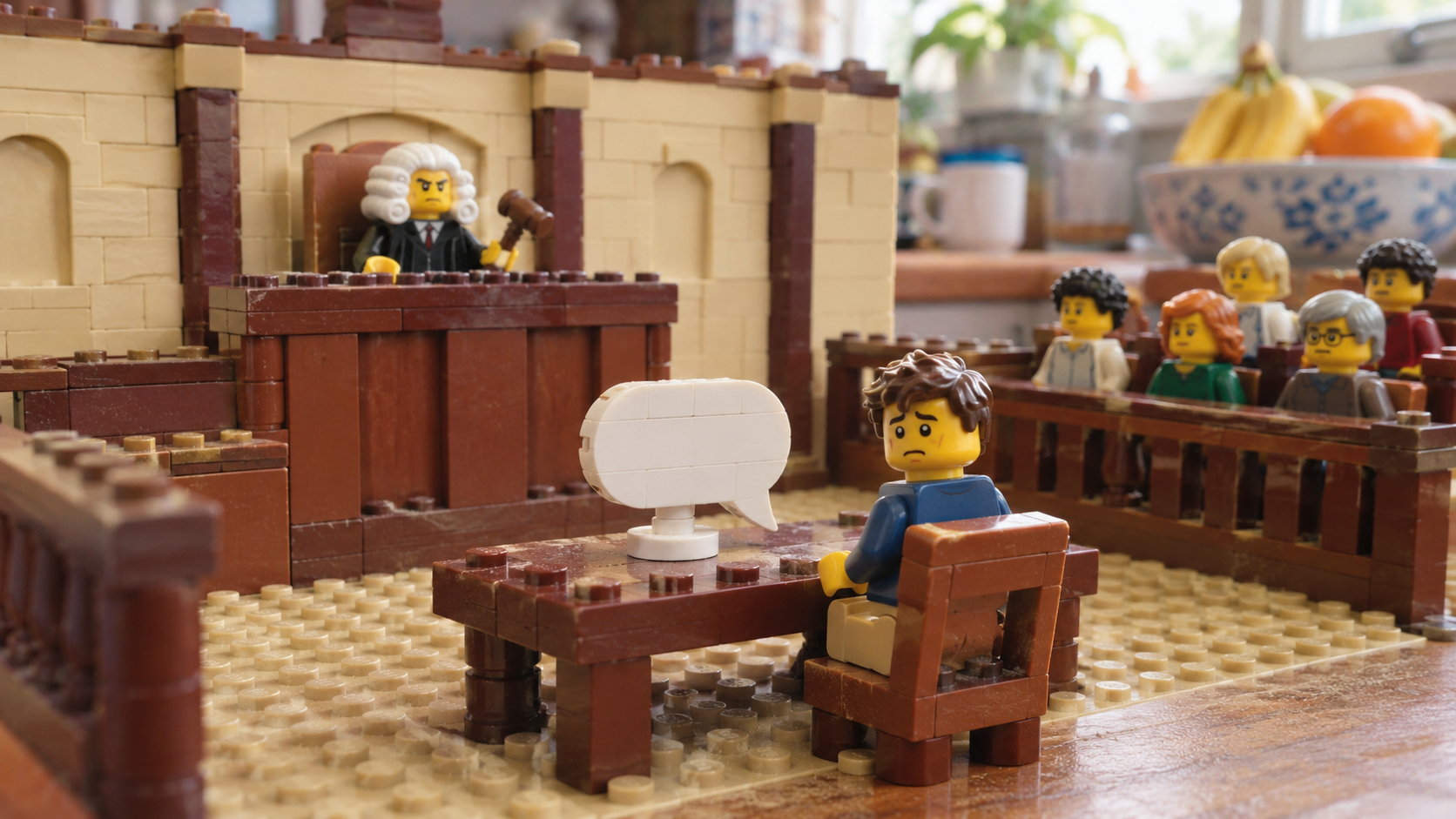
A small comment can stay with me for hours. Sometimes longer. Sometimes YEARS! Somebody says something casually, probably forgets they said it before they’ve finished the sentence, and my brain quietly puts it in a folder marked EXHIBIT A : EVIDENCE THAT I AM A TERRIBLE PERSON. The prosecution seems to have made up its mind before the trial begins.
It might be a correction. It might be a joke that I’m not quite sure was a joke. It might just be someone sounding a bit short because they’re busy, tired, or trying to get through a Tuesday. I can know all of that and still take it personally.
The trouble is that I don’t just hear the comment. I hear the comment, then the possible meaning, then the possible meaning of the possible meaning. By the time I’m finished, the other person has moved on and I’m holding a full disciplinary hearing in my head. I am the accused, the witness, the prosecutor, and, somehow, the person who has to tidy up afterwards.
The comment that keeps on giving
Criticism is difficult even when it is meant kindly. If someone tells me I have got something wrong, I can understand the practical information. I can even agree with it. Somewhere underneath that, though, another part of me is busy translating:
You made a mistake.
Into:
You are a mistake.
That translation happens remarkably quickly. There is no helpful little pop-up asking whether I would like to accept or reject the interpretation. It just installs itself. The prosecution doesn’t distinguish between a mistake and a character flaw; one small piece of evidence is apparently enough for a verdict.
And perceived criticism can be worse, because there is nothing solid to push back against. The other person may have been making an offhand remark. They may not have been criticising me at all. They may have meant nothing beyond the words they actually said. Meanwhile, I’m replaying their tone, the pause before it, the look on their face, and whether they used a full stop in a message.
A full stop. The tiny black dot that can apparently turn “That’s fine.” into a referendum on, and subsequent trashing of, my entire personality. I know that sounds flimsy as evidence. The prosecution proceeds anyway.
I know this can be unfair to the person who made the comment. They may be entirely unaware that anything has happened. I don’t want to claim they were cruel when they weren’t. But good intentions don’t seem to reach the part of my brain that has already started listing my defects.
The court stays in session

What follows is an awful lot of thinking, although “thinking” makes it sound more useful than it is. It’s a bit like watching Doctor Strange race and blur through possible timelines to find the one where the Avengers beat Thanos, except I’m searching for the version of a conversation where I said the right thing and nobody is secretly annoyed with me. My stakes are lower. The number of replays is not. The conversation may be over, but the court stays in session.
I replay what I said. I work out what I should have said instead. I consider whether I should apologise, explain, disappear, or send a message that begins, “Sorry, I might be overthinking this, but…” Then I worry that sending that message will itself be annoying. That’s my infinite apology loop again: I’m often told I say sorry too often, and have even found myself apologising for apologising. The prosecution may want to enter the whole loop as evidence. I can spend a surprising amount of time trying to avoid being a nuisance, while privately being an enormous nuisance to myself.
The comment might have been small. The response inside me is not. I can end up feeling ashamed, stupid, unlikeable, and tired of being me. I beat myself up over a sentence someone else may no longer remember. It is an absurd arrangement: another person makes one remark, and I volunteer for the overnight shift.
I wish I could say that knowing this pattern stops it. It doesn’t. Sometimes I can notice what is happening and still be caught in it. I can tell myself, “They probably didn’t mean that,” while another part of me replies, “Yes, but what if they did?” The second part is very persistent. It has the confidence of someone with a clipboard.
Is there a name for it?
I have come across the term Rejection Sensitive Dysphoria, usually shortened to RSD. It seems to describe something I recognise: taking possible rejection or criticism with an intensity that feels wildly out of proportion to the original moment.
I’m careful about saying “I have RSD”. I’m not diagnosing myself, and the research is still developing. A recent review of research on autistic adults found that the studies use different definitions and approaches, and that there is not yet a settled picture of what RSD means or how it should be understood. That doesn’t make my experience imaginary. It does mean I should be cautious about treating a useful label as a complete explanation. It may help me name the case, but it doesn’t settle the verdict.
Maybe the label fits me. Maybe it explains one part of what happens, alongside anxiety, self-esteem, autism, or the general difficulty of being a person with an overactive internal complaints department. I don’t know. I do know that the pattern is familiar: a remark lands, I take it to heart, and my brain makes sure I feel it long after the conversation has ended.
It would be nice if I could grow a thicker skin. People say that as though you can order one online, perhaps with next-day delivery. I suspect mine would arrive in the wrong size and I would worry the courier thought I was difficult.
For now, I’m trying to remember that the first interpretation is not automatically the correct one. A comment can be awkward without being a verdict. A correction can be about what I did, rather than who I am. And sometimes “That’s fine” is just fine, even with the full stop.
I don’t always believe this when I need to. But I’m trying to give the defence a chance to speak before I convene the next hearing.