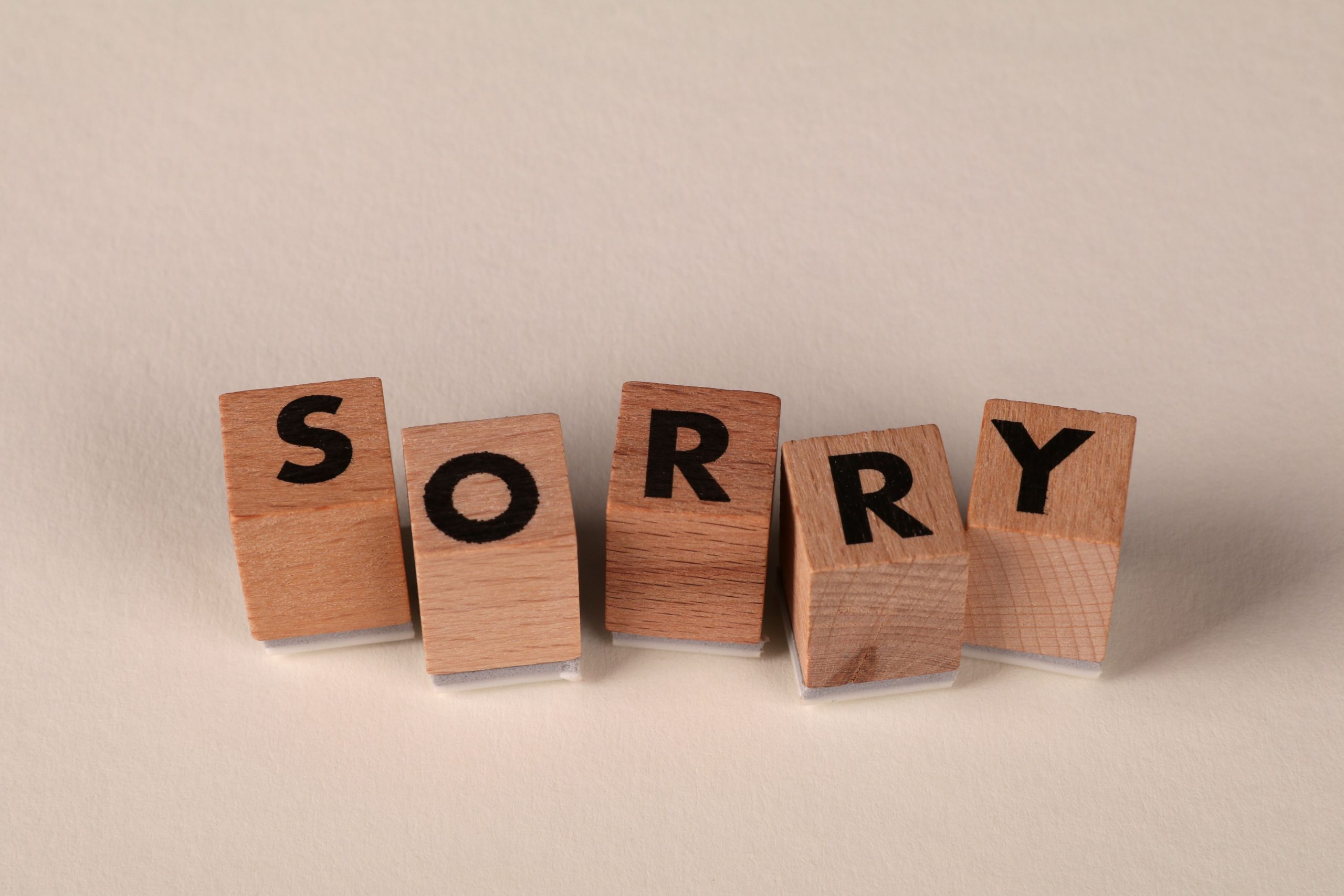
British musician Elton John once sang the words “Sorry Seems to Be the Hardest Word” in his 1976 hit of the same name.
But, y’know, I’ve never had this problem.
If anything, I find the word “sorry” easy.
TOO EASY!
I’m forever saying sorry. Sorry for things that are my fault, sorry for things I THINK are my fault, sorry for things that aren’t remotely my fault, and even sorry for things that couldn’t possibly ever be my fault.
Put it this way, later in Elton’s song he asks what he should do when lightning strikes him.
Me? I’d probably apologise to the cloud for causing it to strike me just because I happened to exist within its sphere of awareness.
Know how I’ve mentioned my lack of ego and self-effacing tendencies before? Well, it also seems I have a nigh-on pathological urge to accept blame for the woes of the world.
I’ve apologised when somebody else bumped into me.
When someone asked me a question I didn’t know the answer to? “Sorry.”
When I’ve needed to squeeze past somebody who has positioned their trolley sideways across an entire supermarket aisle? Somehow, some way, I apologise.
Someone misunderstands something I thought I’d said perfectly clearly?
“Sorry, what I meant was…”
If the weather is disappointing while somebody is visiting me, a small part of me feels I should probably apologise for that too.
Perhaps the ultimate British achievement is saying sorry to an inanimate object after I’ve walked into it.
I’m beginning to suspect that “sorry” isn’t an admission of guilt for me.
It’s punctuation.
The evidence against me
It’s 1989. I’m in my “gap year” before university, except my gap involved going to a local technical college to pick up a plethora of assorted qualifications while I decided what I actually wanted to study at uni.
I did a ScotVec certificate in computer science because it interested me, and I thought it might prove useful when I went on to study mathematics. Probably.
I lived in the halls of residence directly across from the college. Literally less than a five-minute stroll from my room to class.
I was a goody two-shoes student. Always on time, usually early, and always near the top of the class. Teacher’s pet, some would say.
My friend?
He had real issues getting out of bed.
At weekends he’d emerge at around 4pm. Not ideal when classes started at 8:30 in the morning.
Anyway, his attendance had become so bad that he was at risk of being dropped from the course. As he was my friend, I said I’d help get him up and into class.
So I went to his room, knocked him awake, got him ready, and ushered him along. It was like waiting for ice-cold honey to pour. I eventually managed to get him out of his room and across to college.
We walked into class, ooh, ten minutes late?
Which, for him, was early.
The teacher exclaimed that he was “almost on time for once!”, basically acknowledging my role in getting him there at all.
Then he added that if my friend fell back into his bad ways, he’d be out on his ear.
And, totally unbidden, I responded:
“Yes, sorry sir. It won’t happen again!”
Both the teacher AND my friend looked at me with bemused puzzlement.
Hang on.
What exactly was I sorry for?
Sorry for getting him there almost on time? Sorry for making an effort to help a friend?
Why exactly did I feel I had to apologise?
Sorry, but WHY am I sorry?
I am naturally subservient. I’ll walk at the rear of a group or let others pass through a doorway before me. If I join a queue at the same time as someone else, or sometimes even slightly before them, I’ll often let them go ahead.
I’m also very conscious of people entering my personal space, so I think I’ve unconsciously concluded that everyone else must feel the same way. I therefore spend an unreasonable amount of time trying not to inconvenience people who have shown absolutely no sign of being inconvenienced.
This frequently involves moving out of somebody’s way when I wasn’t actually in their way, thereby moving directly into their way.
“Sorry.”
I’m constantly apologising.
Sometimes “sorry” seems to mean:
I don’t want you to think I’m rude.
I’m about to inconvenience you by approximately four seconds.
I disagree, but I’d quite like us still to be friends afterwards.
I need something from you.
I have an opinion.
I’m sorry I exist where you can see or hear me.
Actually, I’m sorry I exist.
Full stop!
I do wonder how much of my constant apologising is actually about guilt, and how much is simply social lubrication.
But it’s got out of hand.
My wife will yell at me:
“PETE! For goodness’ sake! Stop saying sorry all the time!”
To which I naturally respond:
“Yeah… sorry about that!”
And the worst thing is, I’m not even trying to be funny. The apology has already left my mouth before the part of my brain responsible for quality control has arrived at work.
I have created the infinite apology loop.
I just need to find a way to extract energy from it and I’ll make my fortune in power generation.
The tiny negotiation hidden inside “sorry”
I think an apology can be less about admitting I did something wrong and more about signalling intent.
“What I’m about to say isn’t intended to make your life more difficult.”
Or:
“I realise we’re at odds with our expectations here, but I’m not deliberately trying to annoy you.”
It’s an attempt to defuse a situation before anyone has actually planted the explosive device.
One small word has ended up doing an awful lot of jobs.
It covers remorse, politeness, embarrassment, sympathy, interruption, disagreement, and the complex diplomatic negotiations involved in passing someone on a narrow pavement.
Frankly, “sorry” is overworked.
Sorry for taking up space
If I constantly apologise before speaking, asking, disagreeing, or needing something, I do wonder if that affects how I think about my right to do those things.
Not in some grand, life-changing way.
Just in the accumulation of tiny moments.
There is a difference between being considerate and acting as though my very existence requires an apology. I’m not always entirely sure where I cross that line.
Sometimes “sorry” is kindness. Sometimes it’s habit. Sometimes I simply want to avoid friction.
Sometimes I probably just need to get out of the bloody doorway.
Retiring a few unnecessary sorries
Perhaps I need an intervention of sorts.
Not to stop saying sorry altogether, but at least to notice some of the unnecessary ones before they escape.
Maybe “Sorry to bother you” becomes “Have you got a minute?”
Maybe “Sorry, can I just say…” becomes me simply saying it.
And maybe “Sorry I’m late!” becomes…
No, actually, I’ll keep that one for when I’m late.
I’m not an utter barbarian.
I wonder which of my many apologies I’d actually want to keep?
Sorry, I seem to have written an entire post about apologising
I don’t think I want to stop saying sorry.
I’d just like to become slightly better at distinguishing between I did something wrong and two people arrived at the same door at roughly the same time.
There must be some room between never apologising and accepting personal responsibility for the entire human experience.
I’ll try to find it.
Sorry if that takes a while.