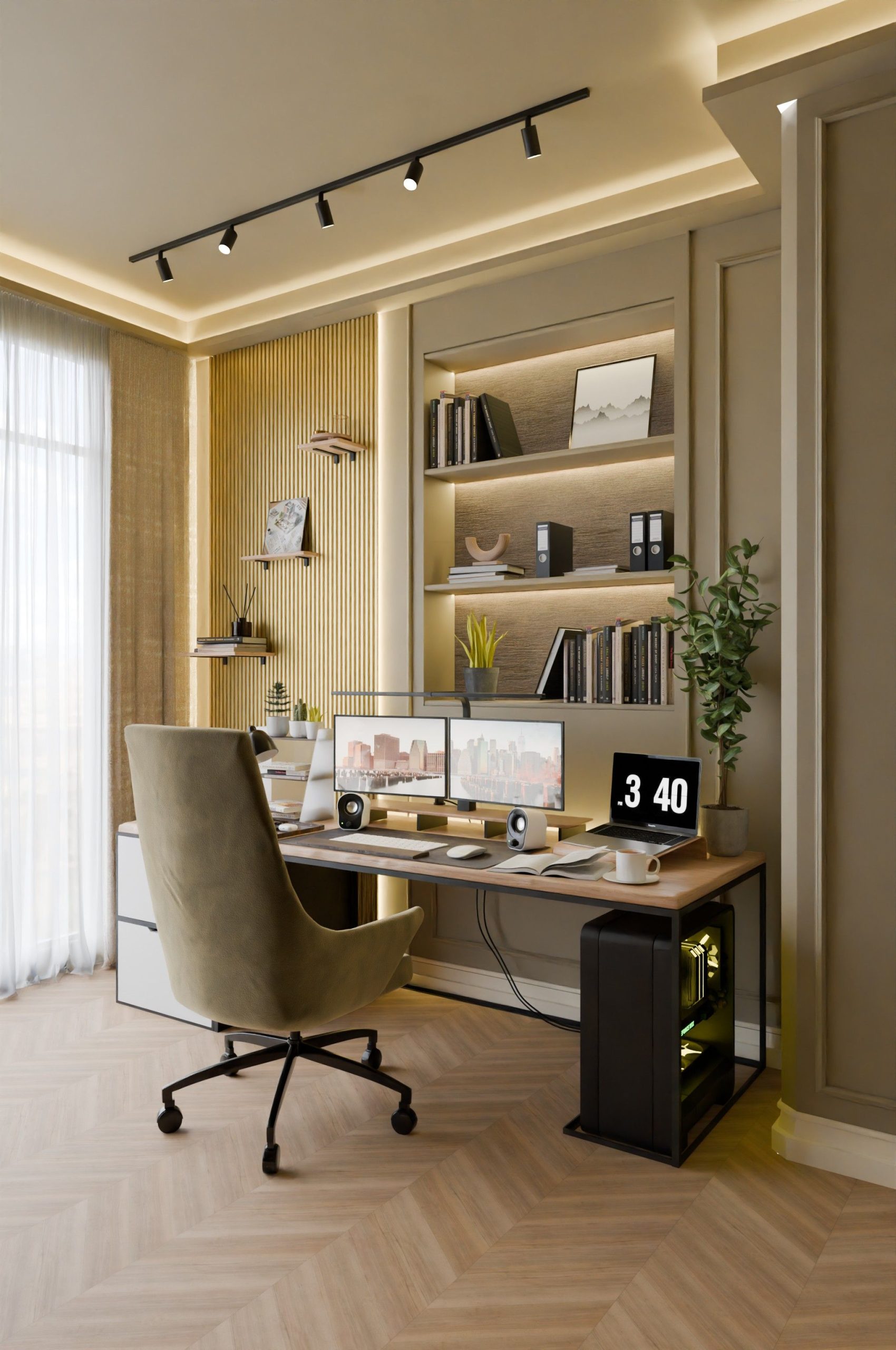
An AuDHD look at working from home, office life, and what happens when your comfort zone becomes very comfortable indeed.
One of the great promises of working from home is that you can finally escape all the unnecessary nonsense of the office.
No commute. No fluorescent lighting. No mysterious person microwaving fish at 11:14 in the morning. No conversations happening three desks away while somebody else is on Teams without headphones and somebody behind you is apparently trying to destroy a keyboard using only their index fingers.
For someone with autism, ADHD, or the increasingly common buy-one-get-one-free combination of AuDHD, this can feel less like a perk and more like the removal of several dozen small obstacles you previously assumed were simply part of having a job.
I can work from home quite effectively.
Increasingly, I do.
And yet I’ve noticed something slightly inconvenient.
If I work from home for a long stretch, the next time I go into the office I find it much harder.
The noise seems noisier.
The movement around me becomes more distracting.
Conversations interrupt my train of thought more easily. People appear beside my desk unexpectedly, which is apparently a completely normal thing for humans to do to each other.
By lunchtime I can feel as though I’ve already done a full day’s work, even if most of the morning was spent doing entirely ordinary office things.
None of this is particularly surprising. What did surprise me was the contrast.
I used to cope with it.
Or at least I coped with it better.
Which left me wondering whether removing stress from my working life had also reduced my ability to deal with stress when it returned.
Had working from home made me softer?
I dislike that wording, because it sounds like something said by my high school PE teacher (Ex Army PT instructor and bane of my youthful existence!) while making me run through freezing mud, but there is something in the question that I haven’t quite managed to dismiss.
The appeal of the cave
There are very good reasons to retreat from environments that exhaust us.
For autistic people, an office can contain a remarkable number of things demanding attention at once.
Phones ring. Doors open. People walk past. Conversations appear and disappear. Somebody has adjusted the heating to a temperature normally associated with commercial bread production.
Then there are the social calculations.
Should I say hello?
Have I said hello already?
Was that person talking to me?
How long am I supposed to stand in the kitchen after making coffee?
Is someone going to ask what I did at the weekend, and if they do, are they expecting the accurate answer or the approved two-sentence version?
ADHD adds its own complications. An office can provide stimulation, which sometimes helps, but it can also provide far more stimulation than you actually ordered.
Working from home gives you control over a surprising amount of this.
You can choose the lighting.
You can control the noise.
You can decide when to speak to people.
You can arrange your desk properly and leave it arranged properly, safe in the knowledge that nobody from Facilities will suddenly announce that everybody is moving three floors down on Thursday.
You can sometimes work according to your natural rhythm rather than the rhythm produced by twenty other people existing nearby.
That control has value.
It can mean having more energy left at the end of the working day.
It can mean concentrating for longer.
It can mean fewer headaches, fewer shutdowns, less masking, and less time spent recovering from things that had almost nothing to do with the actual work.
For some people, home working may simply allow them to do their job better.
There is no prize for completing a spreadsheet or fixing a code bug while simultaneously tolerating a noisy air-conditioning unit.
The problem with becoming too comfortable
Comfort, unfortunately, is rather good.
Once you have discovered that work can happen in a quiet room with your preferred lighting, your preferred chair, your own toilet, and access to coffee that costs considerably less than £3.80, voluntarily returning to the office can feel like an administrative error.
The difficulty is that life rarely agrees to remain inside the environment we have carefully designed for it.
There are meetings.
Appointments.
Family gatherings.
Training days.
Conferences.
Restaurants.
Public transport.
People.
Awful lot of people, actually.
And my working theory, based entirely on observing myself rather than conducting anything remotely resembling respectable science, is that tolerance can change.
Things I encounter regularly become familiar.
Things I avoid can start feeling larger.
When I was regularly in an office, I expected the noise. I had routines. I knew where I sat, when I took lunch, where I could disappear for five minutes, and which parts of the day were likely to be chaotic.
After a long period at home, I lose some of that familiarity.
Then I return and suddenly notice everything again.
The office itself has not necessarily become worse.
My baseline has moved.
That leaves an awkward question, especially for neurodivergent people who have spent years being told to endure environments that were genuinely harmful.
When does protecting yourself become avoiding something?
And when does exposing yourself to something stop being useful and start being pointless suffering?
I don’t think those questions have universal answers.
Annoying, really. A five-point solution would make this article much easier for me to finish.
Exposure is not automatically good
There is a dangerous version of this argument that says we should deliberately make ourselves uncomfortable because discomfort builds resilience.
Don’t get me wrong, sometimes it does.
Mostly it just makes Tuesday horrible.
There is a difference between gradually maintaining familiarity with an environment and repeatedly forcing yourself through something that leaves you exhausted for days.
If spending one day in the office costs you the following evening and half of Wednesday, that belongs in the calculation.
If home working means you can concentrate properly, communicate more clearly, and finish the day with enough energy to cook dinner rather than staring into a cupboard for six minutes, that matters too.
Avoiding unnecessary stress is not cheating.
We have air conditioning because being too hot is unpleasant and sweating buckets into your laptop isn’t a useful skill to learn. We wear glasses because it transpires that squinting at everything builds character and increases resilience remarkably slowly.
The fact that just because you can tolerate something does not mean you actually need to maximise your exposure to it.
Isolation has a cost as well
At the same time, I know what happens when my own world gets too small.
Things become easier.
Then easier becomes normal.
Then normal becomes necessary.
A trip into the office starts feeling like a major event.
Going somewhere after work becomes less appealing because I have become accustomed to finishing the day already at home.
I have a tendency to become a virtual hermit in my own home on self imposed house arrest. I look out the window and “THE OUTSIDE” in the same manner as Gollum reacts to the Elvish rope he’s tethered to. “IT BURNS US !!”
Casual conversations disappear.
I miss information that never makes it into formal meetings.
I lose those peculiar little workplace interactions that are mostly pointless but occasionally lead to something useful.
There is also the social equivalent of getting slightly rusty.
If I spend several days mostly communicating through text and scheduled calls, spontaneous conversation can feel harder when it returns. Not impossible. Just less automatic.
There is a strange contradiction here.
Removing friction can give me more capacity.
Removing too much friction can sometimes reduce what I feel capable of doing.
I’m still trying to work out where that line is.
The office is not one thing
Part of the problem with conversations about remote working is that we talk about “the office” as though everybody is attending the same one.
They aren’t.
One person’s office is a quiet room with eight colleagues and decent lighting.
Another person’s office is an open-plan aircraft hangar containing ninety-seven people, six sales teams, a coffee grinder, and a man called Steve who conducts all telephone conversations at the volume normally reserved for emergency evacuations.
Likewise, home is not automatically peaceful.
Some people live alone and have a dedicated office.
Some work from a kitchen table.
Some have children, partners, neighbours renovating a bathroom, poor internet, nowhere comfortable to sit, a dog who has appointed itself Director of Incoming Deliveries, or a cat that thinks your laptop keyboard is the most comfortable cat bed ever!
Some people get energy from being around colleagues.
Others spend energy being around colleagues.
Some ADHD brains work better when other people are present because the activity creates momentum and accountability.
Others experience every passing conversation as a new browser tab opening in their head.
Autism varies just as much.
What is calming routine for one person can become claustrophobic repetition for another.
A universal recommendation starts falling apart quite quickly.
So what are you actually trying to optimise?
This may be a more useful question than asking whether home or office working is better.
Better for what?
Productivity?
Energy?
Concentration?
Career visibility?
Social connection?
Learning from colleagues?
Mental health?
Family life?
Tolerance of busy environments?
The answer might change depending on what you are doing.
If I need several uninterrupted hours to write, analyse something complicated, or disappear into a problem, home has obvious advantages.
If I need informal conversations, quick feedback, or a sense of what everyone else is doing, the office can be better.
There are also days when I simply benefit from leaving the house.
I resent this because it means all those people who say “you’ll feel better if you get out for a bit” occasionally have evidence.
Finding your own mixture
I suspect the useful compromise begins by treating this less like a question of identity.
You do not have to be A Remote Worker or An Office Person.
You can treat location as another part of how you manage your workload.
A few things might be worth watching.
What does the day actually cost you?
Not just whether you survived it.
Notice what happens afterwards.
If an office day is productive but you need the entire evening to recover, that is part of its cost.
If a home day feels comfortable but you achieve very little because the washing machine, fridge, internet, and sudden urge to reorganise a drawer have formed an alliance against you, that belongs in the calculation too.
What happens after several days of either environment?
One day tells you something.
A pattern tells you more.
Does a week at home leave you refreshed?
Or do you become increasingly reluctant to leave?
Does several days in the office help you settle into a rhythm?
Or does fatigue accumulate until Friday becomes a matter of staring at Outlook and hoping nobody notices?
Which tasks work where?
You may not need one rule for every working day.
Deep concentration might belong at home.
Collaborative work might be easier in person.
Routine admin might work anywhere.
There is nothing particularly noble about doing a task in the environment least suited to it.
Are you avoiding discomfort or avoiding damage?
I find this one difficult.
Some discomfort gets easier with familiarity.
Some does not.
If something feels difficult at first but becomes manageable once you settle in, occasional exposure may be useful.
If repeated exposure consistently leaves you overloaded, exhausted, or unable to function properly afterwards, simply doing more of it may not achieve much beyond proving that you can suffer repeatedly.
How much recovery do you need?
Recovery time is easy to ignore because it happens outside the official working day.
An arrangement can look perfectly sustainable between nine and five while quietly consuming everything between five and nine.
That seems like fairly important accounting.
What are you losing by staying home?
This will vary enormously.
Maybe nothing.
Maybe informal learning.
Maybe friendships.
Maybe visibility.
Maybe confidence in dealing with unpredictable situations.
Maybe just the strange comfort of complaining about the same printer with another human being.
It is worth knowing.
What are you gaining?
The same applies in reverse.
Better concentration.
More control.
Less sensory overload.
More sleep.
No commute.
More time with family.
The ability to construct a working environment around how your brain actually behaves rather than how office furniture companies imagine it behaves.
Those gains count.
An experiment rather than a verdict
One thing I am considering for myself is treating office attendance less as an all-or-nothing decision and more as an ongoing experiment.
Maybe I need regular exposure to the office without needing maximum exposure to it.
One or two days might maintain familiarity.
Five days might drain me.
Zero days for several months might make returning unnecessarily difficult.
That is only my version.
Someone else might discover that four office days and one quiet home day works beautifully.
Someone else might realise the office contributes almost nothing useful to their job and that forcing themselves to attend because they ought to be “more resilient” is just a complicated way of becoming tired.
Another person might discover that working from home slowly turns them into a slightly feral creature who considers answering the door an unreasonable social demand.
All valid data.
The useful part is noticing what happens rather than deciding in advance what ought to happen.
Keep track for a few weeks.
Where did you work?
How productive were you?
How tired were you afterwards?
How much did you dread the next day?
Did you speak to anyone?
Did you concentrate?
Did you recover?
Did you enjoy any of it?
That last question deserves to be in there somewhere.
Then change the mixture.
One more office day.
One fewer.
Half-days, if they are possible.
Office days for meetings and home days for concentrated work.
Avoid consecutive office days.
Or deliberately use consecutive days because the first day is always the difficult one and the second is easier.
There are a lot of combinations between permanently hiding in your house and enthusiastically hot-desking five days a week.
I’m fairly sure my own answer sits somewhere in that untidy middle.
I like working from home. I am better at some things there.
I also suspect I need to keep putting myself into the world often enough that the world does not start feeling impossibly loud whenever I encounter it.
How often that needs to happen is something I am still working out.