Tag: autism

  • The Surprisingly Bearable Lightness of Being Alone

    The Surprisingly Bearable Lightness of Being Alone

    My wife and I can happily spend an entire evening in the same room, each doing our own thing. She’s reading, knitting, or crocheting. I’m probably tinkering with something, researching some obscure Minecraft modpack code on my tablet, or catching up on Mastodon. The cat is supervising, as befits her position as Supreme Leader of the Household.

    We’re together without constantly demanding each other’s attention.

    Our cat has very clear rules about social interaction.

    She wants company.

    Until she doesn’t.

    She wants affection.

    Until she doesn’t.

    She wants to sit on your lap.

    Until she suddenly remembers she’s an apex predator and bites you.

    In many ways, she’s taught me something rather profound about companionship. It’s perfectly possible to enjoy company without needing it every waking moment.

    I do, however, usually manage not to sit in people’s laps and bite them.

    Growing Older (Or How I Learnt to Stop Socialising and Love Solitude)

    From my mid-twenties to my mid-thirties, I lived alone in a flat in Aberdeen. I had an extensive movie collection, back when films came on gloriously space-hungry VHS cassettes instead of DVDs. I had my PC, my World of Warcraft account, and my hamster, Quark.

    Also I had a group of ex-university friends who regularly dragged me out to clubs, pubs, Sunday morning greasy fry-ups, and parties.

    I went because I thought that was what people were supposed to do.

    Don’t get me wrong. I had fun… ish.

    I didn’t know I was autistic back then. That particular bombshell hadn’t even been manufactured yet, never mind dropped from an overhead B-52.

    But most of the time I was on my own. I’d spend evenings watching films, playing games, or trying to work out where Quark had managed to roll his exercise ball this time.

    I was content.

    I enjoyed my own company.

    Even then, I instinctively understood there was a profound difference between being alone and being lonely.

    I’m now in my mid-fifties, and that feeling hasn’t changed.

    As I’ve written before in Growing Old without Growing Up, getting older hasn’t made me feel old. If anything, it’s made me more comfortable ignoring society’s expectations.

    I genuinely enjoy my own company.

    That doesn’t mean I don’t enjoy spending time with my wife. Quite the opposite. She’s my companion, my best friend, my soulmate, and the person I most enjoy sharing life with.

    But we don’t live in each other’s pockets.

    She has her allotment. While I greatly appreciate eating what she grows, that’s her thing. She’ll happily disappear there for hours while I disappear into my home office to write code, build a new Minecraft mod, or update this blog, as I’m doing now.

    She’s even been known to disappear to Greece for a fortnight on one of her spiritual retreats while I stay at home, work, look after the house, and consume quantities of junk food that would never pass Wife Quality Assurance.

    Two Whole People

    I’ve never liked the expression “my other half”.

    It suggests we arrive in the world as unfinished jigsaw puzzles, wandering around until someone finally turns up holding the missing piece.

    I don’t believe that.

    When my wife and I married, we were already two complete human beings, each with our own interests, quirks, ambitions, and ways of spending our time.

    We simply chose to walk through life together.

    Sometimes our paths overlap completely.

    Sometimes they briefly diverge.

    Most of the time, they run happily alongside one another.

    Healthy relationships aren’t two halves making a whole. They’re two complete people choosing to share their lives. Otherwise we accidentally make relationships responsible for fixing problems they were never designed to solve.

    Alone Is Not Lonely

    I’m not antisocial, and I certainly haven’t given up on people.

    I just don’t need quite so many of them.

    I’ve stopped mistaking constant interaction for happiness.

    It turns out the old saying “quality over quantity” applies to friendships as much as almost everything else.

    Being alone is a description while being lonely is an emotion.

    One tells you who’s in the room, the other tells you how you feel about it.

    You can feel desperately lonely in the middle of a crowded pub.

    You can spend an entire weekend by yourself without feeling lonely for a single moment.

    They’re completely different states.

    We often assume one causes the other.

    It doesn’t.

    Why We Fear Solitude

    Modern life seems oddly suspicious of solitude.

    There’s an unspoken expectation that adulthood should involve an ever-expanding network of friends, colleagues, networking groups, WhatsApp chats, neighbourhood associations, social media platforms, and community events.

    As though popularity can somehow be measured by unread notifications.

    But relationships aren’t Pokémon.

    Collecting more doesn’t necessarily improve your life.

    You certainly don’t need to catch them all.

    Learning to Enjoy Your Own Company

    If you can’t enjoy an afternoon by yourself, adding another person doesn’t magically create contentment.

    Sometimes it simply creates another person to disappoint.

    There’s a quiet confidence in being able to entertain yourself, pursue hobbies, disappear down strange rabbit holes of curiosity, spend an afternoon wandering around a museum, sit beside a river watching the world go by, or simply think.

    Many of us have felt far lonelier surrounded by people we couldn’t truly be ourselves around than we ever have sitting quietly on our own.

    Company is wonderful when it’s shared with people who let us be authentic.

    Company simply for the sake of avoiding silence can feel surprisingly empty.

    I’m not suggesting we all become hermits.

    Please don’t finish reading this article, delete all your social media accounts, and move into a cave somewhere in the Highlands.

    We’re social creatures, and spending time with people we care about can be deeply rewarding.

    Some of my happiest memories involve my wife.

    Others involve good friends.

    But some involve nobody else at all.

    Cycling through the countryside.

    Sitting in a park watching deer run across a field.

    Heading into London with absolutely no plan beyond wandering wherever curiosity takes me.

    Looking at things.

    Really looking.

    Watching boats drift along the Thames.

    Eating an excellent burger.

    Drinking great coffee.

    Spending far too long in a bookshop.

    Simply sitting and watching the world move around me without feeling any obligation to join in.

    Bliss.

    Maybe the goal isn’t to spend less time with people.

    Maybe it’s simply to stop measuring the health of our lives by how many people happen to be in the room.

    Being alone isn’t the opposite of belonging.

    Sometimes it’s simply the place where you finally belong to yourself.

    As I finished writing this, Spotify decided to shuffle on All By Myself by Eric Carmen.

    I laughed out loud.

    Not because it proved my point, but because somewhere inside the vast collection of algorithms analysing my listening habits, a computer had spectacularly misunderstood me.

    Then again, perhaps that’s the whole point.

    Being alone and being lonely aren’t the same thing.

    Spotify still hasn’t worked that out.

    Besides, the song got one thing wrong.

    I wasn’t by myself.

    My wife was in the next room.

    The cat was almost certainly plotting something.

    And, perhaps most importantly, I was already exactly where I wanted to be.

  • The Slow Creep of Autistic Burnout

    The Slow Creep of Autistic Burnout

    One of the more irritating things about autistic burnout is that it rarely arrives with the theatrical flourish I imagine. There is no dramatic collapse, no warning klaxon, and no helpful message from my brain politely informing me that I’m running critically low on mental resources and should pull over at the next convenient lay-by for a recharge. That would be far too convenient. Instead, burnout usually sneaks up on me.

    It’s less like falling off a cliff and more like gradually walking into the sea. I don’t notice the water reaching my ankles because I’m too busy concentrating on the horizon. Then the water is up to my waist and I’m still too busy focusing on my destination. Before I realise it, I’m out of my depth, floundering slightly, unable to feel the bottom, and wondering which direction the shore lies.

    My day involves a surprising amount of invisible effort. There’s the social masking, the “stage voice” I wrote about in my stammering article, filtering background noise, monitoring facial expressions, trying to remember whether I’ve made enough eye contact to appear interested without accidentally crossing into “slightly unsettling”, keeping track of conversations, and trying not to infodump about slide rules, cravats or my nihilistic theory of human existence. None of those things are particularly difficult in isolation, but together they’re like dozens of little computer programs quietly running in the background. Each one consumes a little memory, a little processing power, and a little battery until, eventually, I simply run out of something to give.

    I’ve started thinking about burnout less like stress and more like a battery. Most people notice when their phone reaches five per cent. My autistic battery has the remarkable ability to leap directly from sixty per cent to, “Why am I irrationally irritated because somebody stacked the dishwasher incorrectly?” Looking back, the warning signs are actually fairly obvious. The world seems louder than usual, conversations start feeling like hard work, and even simple questions such as “What do you fancy for dinner?” suddenly require the computational resources of a AI server farm. Eventually I reach the point where I no longer want to see or speak to anyone, not because I dislike people or because I’m depressed, but because my brain has quietly put a little sign on the door saying, “Capacity reached. Please call again tomorrow.”

    This is perhaps the biggest misconception about burnout. It isn’t laziness, a lack of motivation, or “not trying hard enough”. If anything, it usually arrives because I’ve been trying too hard for too long. I often picture it as carrying a rucksack while somebody quietly drops another pebble into it every day. One pebble isn’t a problem. Neither are ten, or fifty. The trouble is that one day I realise I’m carrying several thousand of the things and I’ve become so accustomed to the weight that I’ve forgotten life wasn’t always supposed to feel this heavy. That’s what burnout feels like to me. It isn’t one dramatic event. It’s the cumulative effect of hundreds of tiny demands, each insignificant on its own, quietly adding up until my brain eventually decides it’s had enough.

    The frustrating thing is that I already know what helps. The solutions are spectacularly uninteresting. More sleep. Less noise. Fewer demands. Time with people I trust. A walk somewhere green. Music. Noise-cancelling headphones. A mug of coffee. None of this is revolutionary, and none of it would sell many self-help books, but it works. The difficult part isn’t discovering the solution. The difficult part is giving myself permission to stop before my brain makes that decision on my behalf.

    At fifty-something I’ve become slightly better at recognising the warning signs. Not because I’ve become particularly wise, but because I’ve ignored them often enough to recognise the consequences. These days, if the world suddenly seems louder than usual, if every conversation feels like hard work, and if the thought of another Teams meeting fills me with existential dread, I know it probably isn’t the world that’s changed. It’s me. That’s usually my cue to slow down before my brain pulls the emergency brake and does it for me.

    Sadly, I do not always pull the emergency cord in time, and sometimes I get so overloaded that I am barely capable of leaving the house. The most banal tasks become Herculean, and routine things I do every day suddenly take on a distinctly Sisyphean quality until it all becomes, well, too much. I have been in that stage fairly recently. Instead I ignored the warnings, went on against my brain’s better judgement, and then promptly fell over. Naturally, I paid the price and am now trying to pick up the pieces. At least I noticed it fairly early in the burnout process and had not sunk too deeply into the depressive mire that can accompany it. I am still close enough to the edge to grab a low-hanging branch and haul myself back out. Muddied, exhausted but still in one piece.

    Perhaps the biggest lesson burnout has taught me is that being autistic or having ADHD isn’t just about the things other people notice. It’s also about the invisible effort that nobody sees. The conversations that looked effortless. The office that seemed manageable. The shopping trip that appeared uneventful. The social gathering everyone assumed I enjoyed. Sometimes my greatest achievement on any given day is convincing everyone else that I’m coping effortlessly. Burnout is often the bill arriving several weeks later.

    I’ve finally stopped thinking of myself as a machine that ought to run continuously. Batteries aren’t defective because they eventually need recharging, and neither am I. Every time I’ve ignored the warning signs and tried to keep going, my brain has eventually overruled me anyway. These days I try to recognise when my own battery is running low and quietly plug myself back into the charger before the screen goes completely black.

    Even if, occasionally, I don’t manage. At least I tried.

  • The Difference Between Sound and Noise.

    The Difference Between Sound and Noise.

    I’m a bit of a contradiction when it comes to my autistic sensibilities.

    I cannot tolerate noise.

    Office chatter, traffic noise, dripping taps, ticking clocks, snoring, eating sounds (misophonia), or other people’s phone calls and conversations in general.

    This would lead you to think I am sensory avoidant and, to some extent, I am.

    However, My autistic noise sensitivity has an exception, I adore music.

    Music is one of my great pleasures in life.

    My noise-cancelling headphones are rarely off my head. I wear them as soon as I leave the house or office and listen to music constantly.

    My musical tastes can best be described as:

    “Yes.”

    On any given day I might listen to progressive rock, punk, heavy metal, opera, film soundtracks, musical theatre, dad rock, classical music, or, on particularly unusual afternoons, Mongolian throat singing.

    Spotify’s recommendation algorithm has long since given up trying to profile me and now simply appears to be selecting tracks using a random number generator and mild panic.

    In the world of sound there is a profound difference between music and noise.

    Music is controlled, predictable, and chosen.

    Noise is intrusive, random, unwarranted and, in most cases, unavoidable.

    I live in London.

    It’s hardly a haven of peace, calm and quiet serenity and not a place for someone with autistic noise sensitivity!

    Well, bits of it can be. More on that later.

    But the city isn’t designed to be noisy. It’s not even designed to be quiet. Noise is simply an unavoidable side effect of being a large, bustling metropolis.

    London is a loud place.

    Then again, it’s not always about volume.

    It’s about the inescapable wall of sound and its chaotic, unpredictable nature.

    Noise Fatigue

    Being constantly immersed in a sea of sound is draining.

    Much like Chinese water torture, it slowly chips away at my calm and increases my cognitive overload. External noise increases my internal static and makes my stammer worse.

    This results in difficulty concentrating, feeling worn out, exhaustion and an increased likelihood of meltdown.

    Death by a thousand auditory paper cuts.

    The Survival Equipment

    In order to get through the day with minimal fuss, I have an everyday carry survival kit.

    • My noise-cancelling headphones (a battered pair of Sony WH-1000XM3s held together with duct tape)
    • Loop Quiet earplugs
    • A spare set of fallback Bluetooth earbuds (some cheap brand, as I keep losing them)

    My morning routine as I leave the house is:

    Headphones.

    Keys.

    Wallet.

    Usually in that order.

    I’d rather discover I’d forgotten my wallet or my keys than my headphones, which probably says something quite worrying about me.

    More worrying, perhaps, is that I’ve frequently forgotten the latter, but as long as I have my headphones I’m fine.

    I may not be able to get back into the house.

    I may not be able to buy lunch.

    But hey, at least I’m not exposed to noise.

    Havens of Calm in the Chaos

    As mentioned above, not all of London is a hellish soundscape.

    For all its flaws, London has an astounding number of parks, museums, churches and galleries.

    When I’m in the middle of London I can often find much-needed respite by nipping into one of the many parks and listening to birdsong, or by popping into a museum or gallery to calm my inner turmoil.

    And although I’m not a religious person, I do love the peaceful calm of a church or cathedral.

    I can understand why those of a more spiritual nature feel something in such places.

    The peace is almost palpable.

    Like a comforting presence.

    Closing Thoughts

    So yes, I love sound.

    At least, I love music and the sounds of nature.

    I love birdsong, babbling brooks, complex harmonies, soaring orchestras, distorted guitars, operatic voices and whatever noise Mongolian throat singers have somehow persuaded their anatomy to produce.

    What I don’t love is my brain trying to process every single noise in the environment simultaneously.

    The difference between music and noise isn’t volume.

    It’s consent.

    One I invited in.

    The other kicked the door down and started defecating on the furniture.

  • Small Talk Is TCP Handshaking for Humans

    Small Talk Is TCP Handshaking for Humans

    I have long suspected that small talk is not really about talking at all. I mean, obviously it’s about talking, but it’s not about imparting information or saying anything of actual interest.

    It is, I think, more accurately described as a kind of human protocol negotiation. A lightweight exchange whose purpose is not to transfer meaningful information, but to confirm that both parties are present, functional, and broadly willing to proceed without causing a scene.

    In computer networking terms, it feels rather a lot like a TCP three-way handshake.

    That may sound like an over-complicated way to describe “Morning” and “Busy day?” but I maintain it is exactly the right amount of over-complication.

    The analogy works on several levels at once.

    TCP handshakeHuman small talk
    SYN“Morning.”
    SYN/ACK“Morning. Busy today?”
    ACK“Yeah, not too bad.”
    Connection establishedActual conversation may now proceed

    The actual content is almost irrelevant.

    The handshake exists to establish availability, willingness, compatibility, safety, and communication parameters. Small talk does much the same thing. It is not there to win prizes for insight. It is there to say, in the safest possible way:

    I see you. You seem non-threatening. We may now continue.

    That is quite a useful invention, really.

    It is also, for some of us, faintly bewildering.

    Because my brain has a tendency to assume conversations should do one of three things:

    1. exchange useful information.
    2. explore an interesting idea.
    3. contain at least one genuinely terrible joke.

    Small talk often does none of these things.

    Which is not to say it is pointless. Far from it. It is just that its point is not always the same as the point my brain is looking for.

    That can make it feel a bit like packet loss.

    Some of the signal gets through. Some of it doesn’t. A few words arrive intact, but the important meaning seems to have been dropped somewhere between the intention and the execution.

    The weather is discussed.

    The weekend is mentioned.

    A vague inquiry is made about one’s wellbeing.

    And yet the actual data being transmitted is something like:

    I am safe. You are safe. We may continue this interaction without immediate risk of social collapse.

    That is a rather elegant system when it works properly.

    It is also a system with some spectacular failure modes.

    Failed Handshake

    Sometimes the handshake fails immediately.

    You offer the smallest possible opening.

    “Morning.”

    And the other person replies:

    “Is it? I mean the way the world’s going it might as well be the end of days. The planet’s going to hell in a hand basket and we’re all doomed.”

    At that point the connection has not merely failed. It has been forcibly terminated, the cable has been unplugged, and the router has probably started smoking.

    Connection reset by peer.

    Timeout

    Then there is the timeout problem.

    Someone asks:

    “How are you?”

    and the answer requires a socially acceptable level of detail, emotional calibration, and acceptable honesty.

    My brain, meanwhile, is attempting to calculate whether “fine” is technically accurate, whether “surviving” sounds too bleak, whether “not bad” is too British to be believable (see below!), and whether any response longer than six words will prompt a follow-up I do not have the energy to sustain.

    By the time I have finished this internal analysis, the moment has passed.

    Connection timed out.

    Packet Flooding

    Some people go in the opposite direction.

    You offer:

    “Morning.”

    And they respond:

    “Morning! Did you see that interesting show on TV last night about medieval bridge taxation? Made me think about my current view on plug in solar panels, my advancing years, my neighbour’s cat, and the collapse of the world’s democratic politics systems..”

    That is not a handshake.

    That is packet flooding.

    ADHD can do this rather beautifully. One tiny conversational spark and suddenly a completely unrelated archive of information is bursting out of the firewall at speed.

    Which, to be fair, can sometimes be entertaining.

    It just isn’t small talk anymore. There’s nothing small about it.

    Encrypted Traffic

    Us British people add another layer of complexity, because many of us speak in what is essentially encrypted traffic.

    “Not bad.”

    Not only is this British understatement at its very best, this can mean:

    • life is actually pretty good actually!
    • life is acceptable.
    • life is mildly annoying and could be better.
    • life is a bit of a struggle but let us not make a fuss.
    • a bottomless abyss has opened beneath me, but the kettle still works, so we are continuing cup in hand and trying our best to avoid the hordes of demons spewing forth from this hellish portal.

    That is an extraordinary amount of information to pack into two words.

    It is also one of the reasons small talk can be so difficult to decode. The literal words are only half the message. Tone, timing, context, and cultural expectation carry the rest.

    The protocol is not just words.

    It is inference, and unfortunately, not something I’m particularly good at.

    UDP People

    Then there are people who skip the handshake entirely.

    They are the conversational equivalent of UDP.

    “HELLO STRANGER HERE IS MY INFODUMP OF TRAUMAS, PROBLEMS AND CONCERNS!!.”

    No connection setup.

    No reliability guarantees.

    No orderly exchange of packets.

    Just pure, immediate data transfer with absolutely no regard for conventional protocol.

    This can be alarming, but occasionally refreshing.

    Stateful Firewall

    Autistic masking probably deserves its own category here.

    It can feel a bit like trying to pass through a stateful firewall while manually monitoring every tiny aspect of your own behaviour.

    Eye contact? Adjusted.

    Tone? Checked.

    Facial expression? Calibrated.

    Volume? Sensible.

    Response time? Natural enough to avoid suspicion.

    Internal panic? Well hidden, hopefully.

    The result is not always elegant, but it is functional.. barely.

    NAT Traversal

    Trying to socialise at parties is also very much like NAT traversal.

    You know there is a connection somewhere in there.

    You know the other person is a perfectly ordinary human being.

    You know you are supposed to be able to reach them.

    And yet the routing is somehow wrong, the ports are blocked, and everyone is standing in awkward little clusters pretending not to notice that all communication has become mysteriously more difficult than it should be.

    And when you do get into a cluster, the least said about the actual handshaking the better. (Especially Dave with the sweaty palms!)

    So Why Does Small Talk Exist At All?

    Because it is doing a job.

    A very human job.

    Small talk reduces uncertainty.

    It establishes connection.

    It signals intent.

    It gives both parties a safe place to stand before deciding whether to move into more meaningful territory.

    It is a social compatibility check.

    A “yes, we can talk” exchange.

    A way of saying:

    I am friendly.

    You are safe.

    We may proceed.

    That is actually rather beautiful, when you think about it.

    Even if the words themselves are often about absolutely nothing of consequence.

    Why It Feels So Hard

    For many neurodivergent people, the difficulty is not that small talk is meaningless.

    The difficulty is that its meaning is often indirect.

    It is a social ritual disguised as conversation.

    A lot of the work is happening in the subtext.

    And subtext is a slippery little creature.

    If your brain prefers clarity, precision, and explicit information, small talk can feel like being asked to decode a message written in invisible ink.

    Which, admittedly, is not very helpful.

    The Human Side of the Protocol

    And yet…

    And yet, for all my cantankerous grumbling, I do think there is something lovely about it.

    We are, after all, social animals operating a remarkably fragile but surprisingly effective communication system. Small talk is one of the tiny pieces of software that keeps the whole thing from crashing immediately.

    It is how we ease into each other’s company.

    It is how we test for warmth.

    It is how we say, with minimal risk and maximum politeness, that we are willing to share a moment. You’re lowering your shields and allowing the Klingons to beam aboard.

    That is not nothing.

    In Closing

    So yes, perhaps small talk is the human equivalent of a TCP handshake.

    A few neat little exchanges whose real purpose is not the content, but the connection.

    Sometimes it works perfectly.

    Sometimes it fails immediately.

    Sometimes the packets arrive out of order.

    Sometimes somebody starts talking about medieval bridge taxation or python programming before the connection is even established.

    But when it does work, it lets two strangers become, very briefly, not strangers at all.

    And really, that is quite a clever trick for a few essentially meaningless words and a friendly look over a cup of coffee.

  • Why Neurodivergent People Often Become Collectors

    Why Neurodivergent People Often Become Collectors

    I sit here in my home office, surrounded by many little boxes, each containing a strange assortment of items.

    If you’ve read my About Pete page (or followed me here from my Mastodon profile), you’ll know I am a collector of collections. Not content with collecting just one type of thing, I somehow ended up collecting multiple collections. So much so that my collections have effectively become a collection in their own right.

    A collection squared, if you will.

    How did this happen?

    More importantly, why did this happen?

    I used to simply pick up things I found interesting. At some point I realised I didn’t merely “own some things”. I had somehow become the curator of a growing museum dedicated to obscure enthusiasm.

    Slide rules. Rubik’s Cubes. Cravats. Books. Albums and CDs. Fossils and minerals. Obsolete retro technology. Raspberry Pis.

    Left unsupervised long enough, I would probably begin alphabetising pebbles or categorising sawdust!

    What is it about collecting that I find so satisfying? What part of me does it appease? What itch does it scratch?

    Speaking as an autistic person, I know from first-hand experience that neurodivergent brains often experience:

    • overwhelm
    • anxiety around unpredictability
    • sensory chaos
    • cognitive overload

    Collections, and the act of collecting, provide:

    • systems
    • categories
    • rules
    • predictability
    • control

    A collection is a tiny universe whose logic makes sense; a small island of order in an otherwise bewilderingly noisy world.

    Many neurodivergent people possess brains that seem permanently configured to look for patterns. We sort things. We categorise things. We organise things into neat little systems that make perfect sense to us and absolutely nobody else.

    Give us a collection and we won’t simply see a shelf full of objects.

    We’ll see relationships.

    A Rubik’s Cube isn’t just a Rubik’s Cube. It’s a particular mechanism, produced by a particular manufacturer, with a particular turning feel and a particular place in the evolutionary history of twisty puzzles.

    A slide rule isn’t simply a calculator from before calculators. It’s a fascinating collection of scales, layouts and design decisions reflecting the mathematical needs of a particular era.

    Books aren’t merely books. They’re editions, printings, cover variations and publishing histories.

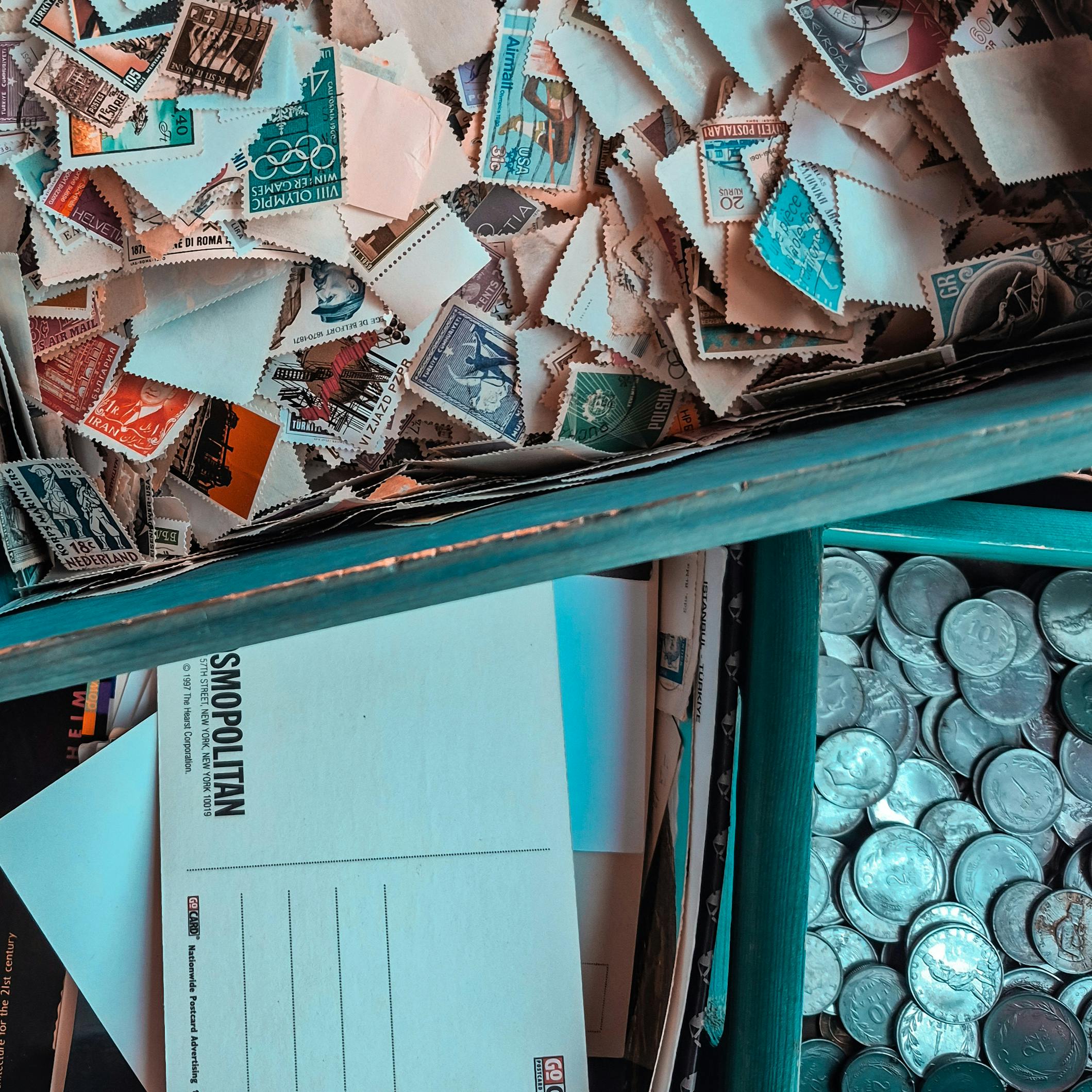
    The same applies to fossils, stamps, coins, model trains, vintage computers, or whatever flavour of obsession has currently attached itself to the brain.

    What often fascinates us isn’t simply the object itself but the system surrounding it.

    The classifications.

    The subtle differences.

    The exceptions to the rules.

    The one obscure variation that only three people on Earth appear to care about.

    Most people look at a shelf and see “a collection”.

    A pattern-seeking brain looks at the same shelf and sees a map.

    Every object has a place. Every category has a purpose. Every missing item creates a tiny itch in the back of the mind that quietly whispers:

    “You know exactly what’s supposed to go there.”

    The collection becomes more than a pile of things. It becomes a system to explore, understand and occasionally obsess over.

    And for brains that derive genuine pleasure from finding order amidst chaos, that’s immensely satisfying.

    Of course, collections aren’t just about categorisation and pattern-seeking. If they were, a spreadsheet would be every collector’s dream and nobody has ever become emotionally attached to a spreadsheet.

    Well… almost nobody. :embarrassed smiley:

    Over time, collections become something more than the objects themselves.

    A favourite book isn’t merely paper, ink and glue. A battered old slide rule isn’t simply a calculating device. A particular Rubik’s Cube isn’t just coloured plastic.

    They become markers in the timeline of our lives.

    Some remind us of places we’ve been.

    Others remind us of people we’ve known.

    Some represent achievements, discoveries or periods when life felt particularly good.

    Others survived difficult times and somehow became associated with comfort, familiarity and stability.

    For many neurodivergent people, objects can provide a reassuring sense of permanence in a world that often feels unpredictable.

    People change.

    Jobs change.

    Circumstances change.

    Favourite television programmes get cancelled.

    Entire social media platforms appear, dominate the internet for five years and then vanish into obscurity.

    But that slightly battered book you’ve owned for twenty years?

    It’s still there.

    That curious fossil sitting on the shelf?

    Still there.

    The collection remains a small constant in an ever-changing world.

    Objects also possess several advantages over people.

    They don’t judge your interests.

    They don’t suddenly decide they no longer like you.

    They don’t require careful interpretation of facial expressions, body language or implied meanings hidden beneath three layers of social convention.

    Most importantly, they don’t initiate small talk.

    I’ve yet to encounter a slide rule that felt compelled to discuss the weather.

    A collection is predictable. It has structure. It behaves according to understandable rules. You know where things belong and what purpose they serve.

    In a world that can sometimes feel noisy, confusing and chaotic, there is something deeply comforting about that.

    Perhaps that’s why collections often become emotional anchors.

    They’re not merely accumulations of objects.

    They’re accumulations of memories, interests, experiences and fragments of identity.

    They’re little pieces of ourselves arranged neatly on shelves.

    The Dopamine Hunt

    Then there’s the dopamine hunt.

    If autism often provides the catalogue, ADHD frequently supplies the expedition.

    For many collectors, the real excitement isn’t owning the item.

    It’s finding it.

    The search itself becomes the hobby.

    Tracking down a rare edition.

    Discovering an obscure variant.

    Learning some wonderfully unnecessary fact about a manufacturing change made in 1973.

    Completing a set that has been taunting you for years.

    It’s part treasure hunt, part side gather quest and part Pokémon for adults with back pain.

    An ADHD brain can derive astonishing amounts of happiness from locating a very specific obscure object that nobody else on Earth appears to care about.

    Hours of searching, weeks of waiting and countless dead ends can all evaporate the moment the target is finally acquired.

    Of course, this creates a slight problem.

    The dopamine was never entirely in the object.

    It was in the chase.

    Which explains why collectors are often found muttering the dangerous phrase:

    “I’m only looking…”

    Right before accidentally acquiring three more items for the collection.

    Some Collections Are Apparently More Respectable Than Others

    One of the more fascinating quirks of society is that some collections are considered sophisticated while others are considered evidence that you should perhaps be supervised more closely.

    Collect vintage wines and you’re a connoisseur.

    Collect rare watches and you’re an investor.

    Assemble a garage full of classic cars and people nod approvingly while using words like heritage and craftsmanship.

    Collect Rubik’s Cubes, slide rules or obscure retro clothing and suddenly you’re “that bloke with all the cubes” or “that fat prat in the cravat”.

    The strange thing is that the underlying behaviour is often identical.

    In both cases someone is spending considerable amounts of money acquiring objects they don’t strictly need, learning unnecessary amounts of information about them and becoming disproportionately excited when they discover a rare variant.

    Apparently spending £10,000 on a watch is a sensible investment.

    Spending £10 on a forty-year-old slide rule is a cry for help.

    I remain unconvinced by this distinction.

    The Danger Zone

    Of course, like most things that bring us comfort and enjoyment, collecting can occasionally wander into less healthy territory.

    A collection can become clutter if it grows faster than our ability to manage it.

    The thrill of acquisition can become an expensive habit.

    The search for the next item can sometimes become more important than appreciating the things we already have.

    For some people, collections can also become a form of avoidance; a way of retreating into a familiar and controllable world when life outside feels difficult, uncertain or overwhelming.

    There’s nothing inherently wrong with any of this.

    Most hobbies have their excesses.

    The trick, as with so many things, is balance.

    A collection should enrich your life, not consume it.

    It should be a source of joy, curiosity and comfort rather than stress, debt or obligation.

    After all, if your collection starts requiring its own collection to keep track of it, it may be time for a quiet sit-down and a cup of tea.

    Physical Objects in a Digital Age

    In an increasingly digital world, I sometimes wonder whether part of the appeal of collections is simply that they are real.

    So much of modern life exists behind glass screens.

    Books become files.

    Music becomes subscriptions.

    Photographs become pixels.

    Entire friendships can be reduced to a collection of messages stored on somebody else’s server.

    There’s nothing inherently wrong with any of that. The digital world has given us remarkable things.

    But digital experiences can sometimes feel strangely weightless.

    A physical object occupies space in the world.

    A book has weight in your hands.

    A fossil connects you to a creature that lived millions of years before the first human wondered where they left their keys.

    A slide rule carries the fingerprints of the engineers, scientists and students who once used it to understand the universe.

    These things have history.

    They’ve travelled through time.

    They existed before you discovered them and, with a little care, they’ll probably continue to exist long after you’re gone.

    Perhaps that’s part of what makes them meaningful.

    When I hold an old slide rule, I’m not simply looking at an obsolete calculating device.

    I’m holding a small piece of human ingenuity.

    A reminder that generations of curious people spent their lives trying to understand the world around them.

    In that sense, collections aren’t really about ownership.

    They’re about stewardship.

    For a little while, these objects become part of our story.

    Then one day they’ll become part of someone else’s.

    There’s something rather comforting about that.

    In Closing

    So yes, perhaps neurodivergent people do collect unusual things.

    But maybe that is because we notice unusual beauty.

    Maybe we find joy in patterns other people overlook, or comfort in systems that make sense to us, or delight in a slightly odd shelf of interesting nonsense that happens to look brilliant in our own particular internal lighting.

    Or maybe we just like collecting things that make us happy and occasionally confuse visitors.

    Honestly, it is probably all of the above.

    And really, that seems like a perfectly reasonable way to spend a life.