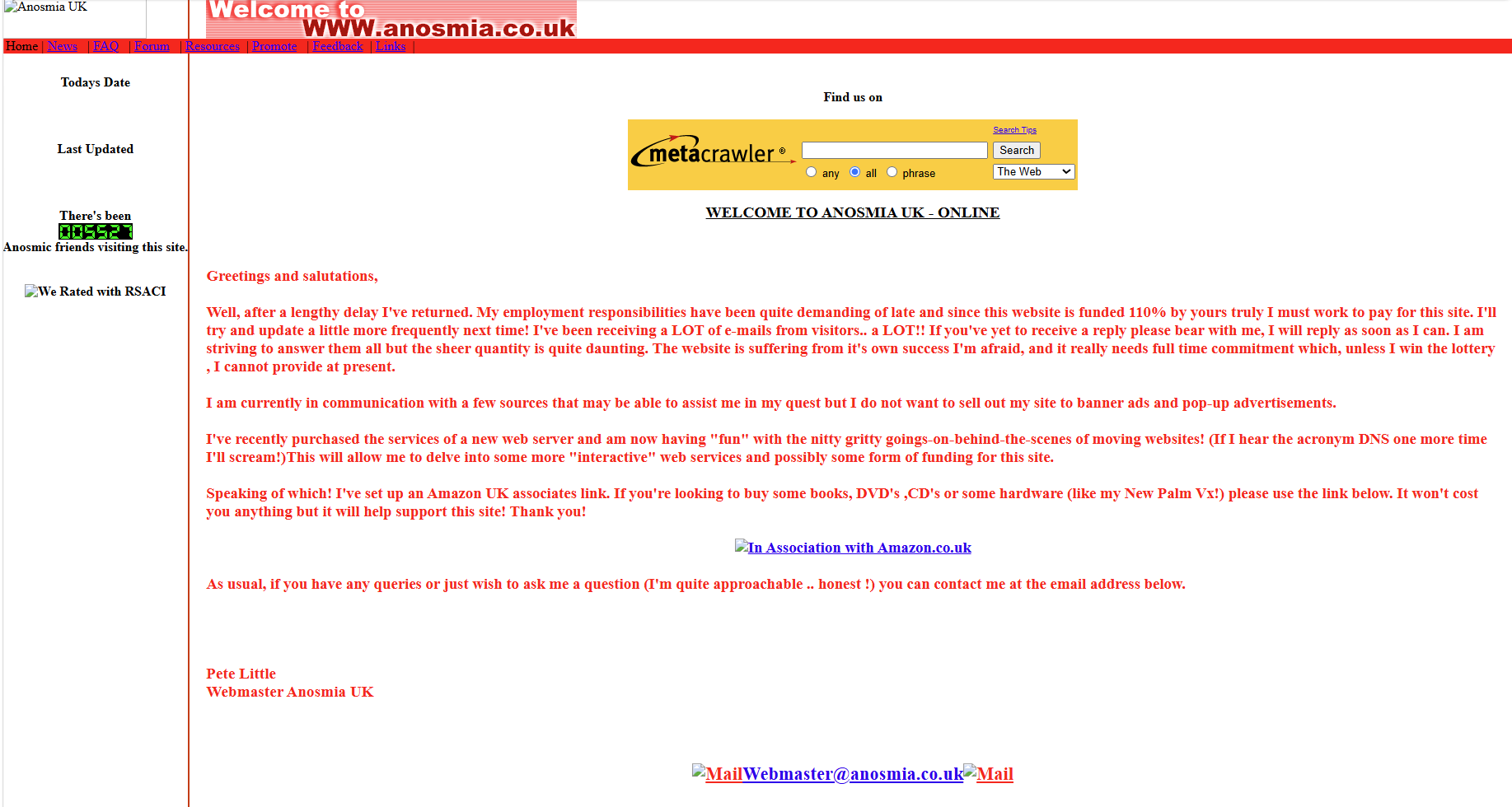
I remember the early days of the internet.
I remember the terrible websites with flashing green text on red backgrounds, animated GIFs in abundance, JavaScript visitor counters at the bottom of the page, MIDI tunes that started playing when you accessed the site, and entire websites dedicated to someone’s hamster.
(Guilty as charged, m’lud.)
And you know what?
It was GLORIOUS!
Don’t worry, this isn’t an “old man yells at cloud infrastructure” post.
The old internet wasn’t perfect, it wasn’t ideal, and it certainly wasn’t always safe.
However, what it was, was quintessentially human.
THE INTERNET USED TO FEEL GEOGRAPHICAL
The actual internet was a highway.
It wasn’t the destination, but the means of travelling between weird towns, villages, and hamlets, each of which specialised in… well… something.
Much like the towns in the Mad Max universe, where you have Bartertown, Gastown, Bullet Farm, and Tomorrow-morrow Land, the internet had Hamsterville, Catopolis, Conspiracy Creek, and Anosmia Acres.
I was a serial website owner.
I ran an anosmia support forum which, somehow, got me on television for my fifteen minutes of fame.
Its design may well have made visitors’ eyes bleed, granted, but as it was a support group for people with no sense of smell, it was perhaps appropriate that my design stank. (See featured image from The Internet archive above!)
I ran a joke conspiracy PHPBB forum called the UK Conspiracy Nexus, where every “member” was another character I had created and all the posts, arguments, and discussions were written by me.
I deliberately invented ridiculous conspiracy theories, such as the connection between Toblerone and Illuminati mind-control dentistry.
It’s the triangular shape, you see.
It was all good fun… until I noticed my posts being shared non-ironically on more “serious” conspiracy sites.
Dear God.
What did I spawn?
I also created a maths and general nerdiness site dedicated to things geeks might find “sexy” (that is to say, cool).
In hindsight, calling it Sex4Geeks was perhaps inviting exactly the sort of dubious attention it received.
That site was short-lived.
It did, however, end up becoming a joke in my best man’s wedding speech.
Pete?
Naive much?
Heck yes.
But the internet was full of things like this.
BBSs.
Usenet.
Forums.
IRC.
Personal webpages written in hand-crafted HTML.
It wasn’t one place.
It was thousands of interconnected little places, each with their own personality, culture, and rules.
You didn’t live there.
You visited.
You travelled between them.
You discovered them.
You got lost.
Wonderfully so.
NOBODY NEEDED A BUSINESS PLAN
The majority of the internet back then existed for one reason.
Someone cared about something enough to make something about it.
Not because they wanted followers, subscribers, sponsorships, or monetisation.
It was because somebody cared enough about model railways, their collection of Tamagotchis, or the history of the China tea trade.
They had passion and they wanted to share it.
There was a website for every niche interest and most of them looked as though they had been assembled during an environmental catastrophe and built entirely in the dark.
THE GREAT CONSOLIDATION
Of course, initially seen as a fad, the internet proved it wasn’t going anywhere.
People realised its potential.
You could now order a pizza online.
Such a technological breakthrough is something we take entirely for granted nowadays.
Companies with ideas and dollar signs in their eyes jumped in.
Slowly, giants emerged from the chaos.
Where once there had been millions of random amateur websites, suddenly you had Facebook, Twitter, and MySpace.
Then YouTube, Reddit, Instagram, and TikTok.
These places acted like magnets, drawing in the weird from the satellite towns, villages, and hamlets, and housing them instead in vast digital metropolises.
THE ALGORITHMS THAT ATE DISCOVERY
Finding things used to be an adventure.
There were a few basic search engines, reciprocal links, blogrolls, and web rings connecting like-minded sites together.
You would wander around them feeling as though you were forging your own path through a strange and fascinating landscape.
You discovered what people made.
You sought out things that interested you.
Now we no longer discover what people made.
We discover what the algorithms, working on behalf of the platforms, want us to see.
Want your site to appear first in search results?
Just pay lots of money.
It’s even worse now with AI-generated summaries appearing above the sites that originally created the content.
In the pursuit of making things easier, we lost something human along the way.
THE DEATH OF WEIRD
The old internet was eccentric, amateur, and personal.
Websites now look polished, optimised, branded, and laden with “smart” features.
The old internet may have looked like a terrible hodgepodge mess, but it looked like somebody.
It was human.
Much of today’s internet looks like a corporation.
A polished, focus-grouped, metrics-driven corporation.
A CONFESSION
Nostalgia is a terrible historian.
As Baz Luhrmann famously said:
“Nostalgia is a way of fishing the past from the disposal, wiping it off, painting over the ugly parts, and recycling it for more than it’s worth.”
The old internet had its fair share of problems.
Awful design.
Scams.
Misinformation.
Toxicity.
Every village conspiracy nut could find a like-minded community and build little echo chambers where the worst ideas fed off one another and grew.
I’m not arguing that the old internet was perfect.
I’m simply saying it was more human.
We still have scams, misinformation, and toxicity.
Now it’s just run by a handful of billionaire puppet masters.
WE LOST MORE THAN WEBSITES
The real loss wasn’t the technology.
That grew.
Who would have imagined we’d one day carry around access to the sum total of human knowledge on a small device that fits in the palm of our hand?
We lost individuality.
Experimentation.
Curiosity.
And yes, weirdness.
The internet became a consumer space for selling content rather than a creative space for sharing ideas.
IN CONCLUSION
Perhaps that’s one of the reasons I reincarnated this blog.
Not because I expect thousands of readers.
Not because I have a monetisation strategy.
Not because some marketing consultant told me to build my personal brand.
No.
Because I miss people having little corners of the internet that belonged to them.
Places where we could be knowledgeable, enthusiastic, eccentric, or even completely wrong about something.
Places that felt human.
The internet may have become a platform, but there’s still room for the occasional strange little website.
Or should I say, in my case, the occasional strange Little website.
This is my own weird nest on the web.