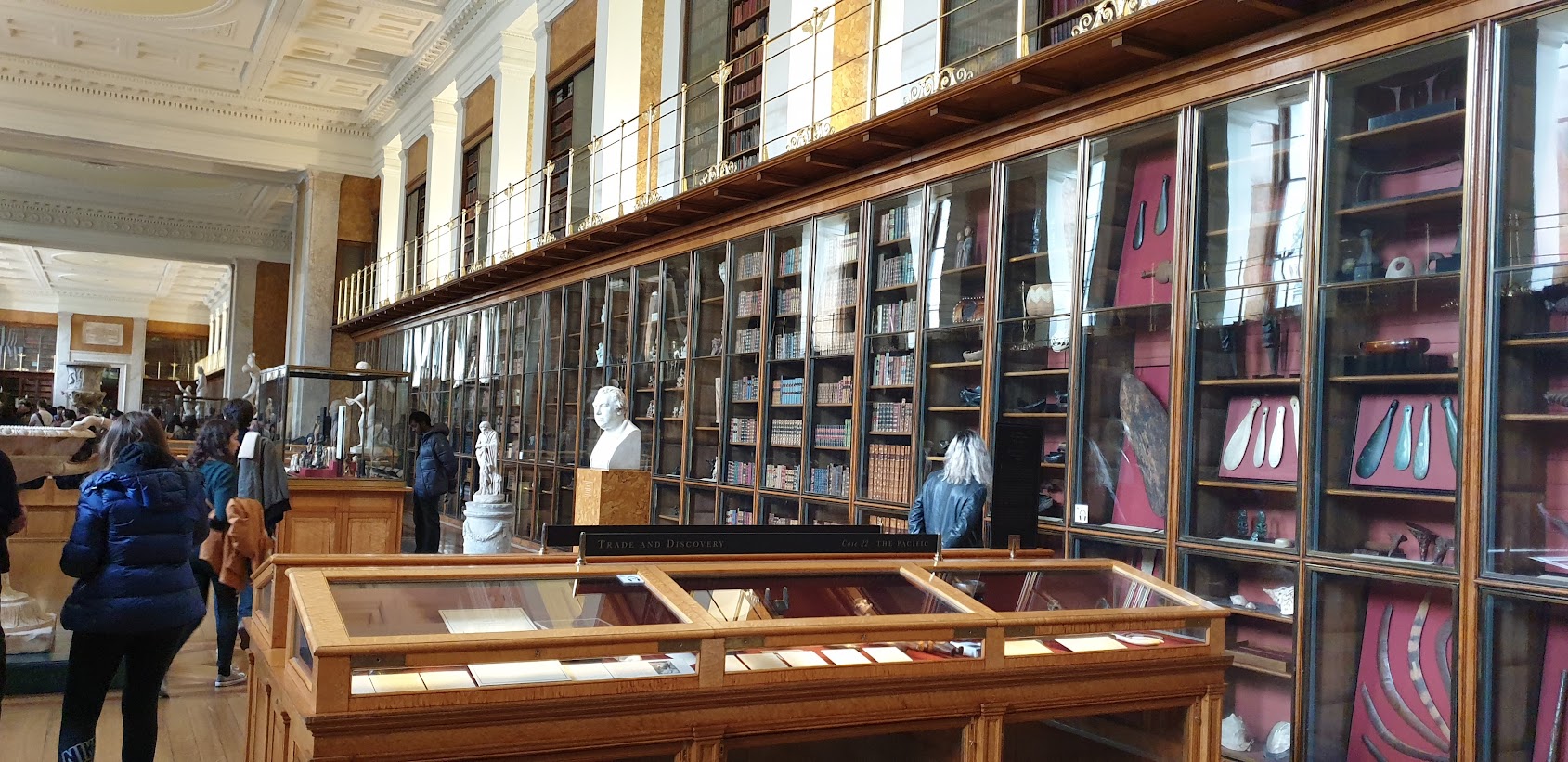
I have yet to visit a museum I didn’t like.
Some have been better than others, certainly, but I have never walked out of one thinking, “Well, that was a disappointing collection of fascinating things.”
Large or small, broad or niche, I love museums. When I’m in London they’re some of my favourite places to spend time, and in London we’re really spoiled for choice. Clustered together in South Kensington you’ve got the V&A, the Natural History Museum, and, just around the corner, the Science Museum. Up in Bloomsbury there’s the OG GOAT, the British Museum, containing some of the very best purloined and, ahem… “enthusiastically acquired” artefacts from the four corners of the globe. (Hey, let’s not get political here. – Ed.)
Further afield there’s the National Maritime Museum in Greenwich, and not forgetting my old stomping ground, the Horniman Museum in Forest Hill, complete with its famously overstuffed walrus.
Those are just a few of my regular haunts.
I don’t really go to museums to “learn” in the formal sense. I go because they’re one of the few places left where curiosity doesn’t need to justify itself. Nobody asks what you’re going to do with the information you’ve just discovered. Nobody expects it to improve your productivity or advance your career. Sometimes it’s enough simply to stand in front of an object and think, “Well… that’s fascinating.”
I can happily spend hours wandering around a museum on my own. Not only do I find them endlessly fascinating, but they’re also havens of calm, quiet, and peace. Unlike the busy, bustling streets or shopping centres, nobody has ever stood next to me in a museum shouting into their mobile phone about printer cartridges.
Well… not usually.
There’s always the annoying exception.
Museums Are Libraries for Things
Books preserve ideas and knowledge.
They also preserve some truly dreadful plots, improbable narratives, and larger-than-life characters, but I digress.
Museums preserve objects.
Every exhibit has a story.
Every exhibit has a history.
Every exhibit has a purpose.
Every exhibit has a journey.
A Roman coin isn’t just a coin. It may have been somebody’s wages. It may have paid for a meal, a night’s lodging, or a particularly good mug of mead. Perhaps it was dropped and lost in the mud, or perhaps somebody carefully buried it for safekeeping and never returned.
A steam engine isn’t just a collection of iron and brass. It represents the Industrial Revolution in miniature. It may have pumped water from a mine, powered a textile mill, or hauled ore from Cornwall to London while quietly transforming the world around it.
Objects are never just “things”.
They’re tiny windows into somebody else’s life.
I’ve often thought that museums are what happen when humanity collectively decides, “We probably shouldn’t throw this away. It might be important later.”
In many respects, a museum is simply a much larger, considerably better organised version of every family’s junk drawer.
The difference is that somebody has already rummaged through the drawer and decided which objects tell the best stories. Museums don’t really preserve things. They preserve curiosity. Every display case is an invitation to ask, “Who made this?”, “Why did they make it?”, and “What was life like for the person who used it?” I don’t always need the answers. Sometimes the questions are the interesting part.
Curiosity Without Purpose
Modern life sends us some rather contradictory messages.
On the one hand we’re expected to keep up with the latest technology, the newest trends, and whatever today’s fashionable productivity hack happens to be. On the other, we’re encouraged to own less, declutter our lives, and throw away anything that doesn’t “spark joy”.
The trouble is, in my case, almost everything sparks joy.
Museums quietly reject the entire premise.
Modern life constantly asks:
“What’s the point?”
Museums simply reply:
“Because it’s interesting.”
And, for me at least, that’s more than enough.
I can happily spend twenty minutes studying a fossil, a Viking comb, or a display of Victorian kitchen utensils. Not because they’ll help me earn more money or make my day-to-day life more efficient, but because they’re fascinating. Sometimes they’re educational. Sometimes they’re beautiful. Often they’re all of the above.
The Peace and Quiet Is Underrated
One of the things I appreciate most about museums is something people rarely mention.
They’re quiet.
They’re orderly.
They’re predictable.
There’s an almost reverential atmosphere about them. People naturally lower their voices, slow down, and actually pay attention to what’s around them.
For me, that’s the complete opposite of a shopping centre.
Shopping centres are frenetic, noisy, crowded, brightly lit, and full of people apparently engaged in some sort of competitive speed-walking event. I find them exhausting.
Museums have the opposite effect.
They calm me down.
They centre me.
I’ve quite happily spent the best part of an entire day in a museum, especially if it has a decent café and an excellent bookshop attached.
Every Object Has a Story
The larger museums cover an astonishing breadth of human experience. One minute I’m looking at Egyptian artefacts thousands of years old, the next I’m staring at inventions from the late twentieth century.
There’s something distinctly unsettling about visiting a museum to look at ancient history and suddenly finding the exact same Trimphone your parents had sitting proudly behind glass.
As I’ve mentioned in previous posts, I’m something of a collector myself. I have numerous collections of things I find interesting, quirky, or simply too fascinating to leave behind.
Museums do exactly the same thing.
Just on a considerably larger scale.
Every object once belonged to somebody.
Somebody designed it, made it, used it, valued it, then sadly lost it.
Then, somehow, it ended up behind glass because somebody else recognised that it was worth preserving.
There’s something deeply human about that.
Whenever I visit a museum I find myself thinking less about the objects themselves and more about the people behind them. Someone sat at a workbench and made this, carried it, repaired it when it broke. And then much later someone else decided it was too important to throw away. Long after they’ve gone, a small part of their life survives behind a sheet of glass, quietly telling its story to complete strangers. I find that oddly comforting.
We Preserve What We Value
Museums aren’t simply rooms full of old “stuff”.
Because every museum is curated, every museum accidentally reveals what a society believes is worth remembering.
Sometimes that’s kings, queens, great battles, famous paintings, or technological breakthroughs.
Sometimes it’s kitchen utensils, railway tickets, children’s toys, wine goblets, or obscure calculating devices.
If I’m honest, it’s often the ordinary objects that fascinate me the most.
Civilisation wasn’t built solely by kings and generals.
It was built day by day by ordinary people.
People who packed lunches.
People who worried about warm clothing.
People who needed decent shoes.
People who wrote shopping lists on clay tablets and prayed to pantheons of strange gods.
Those are the people I find myself wondering about.
Permission to Wonder
This is probably my favourite reason for loving museums.
Somewhere along the line many adults stop asking, “What does this do?” or “Why does it work that way?”
We lose something of our childlike curiosity.
Museums quietly encourage exactly the opposite.
In fact, they almost insist upon it. They invite adults to behave like children again, in the very best sense of the word. To point at things. To ask daft questions. To become excited by a beautifully engineered clock, a dinosaur skeleton, or a collection of eighteenth-century spoons that nobody has thought about for two hundred years. Curiosity, after all, isn’t childish. It’s one of the most profoundly human qualities we possess.
Every display case seems to say:
“Go on. Be curious. Ask questions. That’s what I’m here for.”
If you ask me, and seeing as you’re reading my blog I’ll assume you do, that’s rather lovely.
My Perfect Day
My perfect museum visit involves wandering around without a map.
I don’t think of it as aimless wandering.
I prefer to call it exploring.
I’ll spend far too long reading information boards, become unexpectedly fascinated by a single fossil, discover something I didn’t even know existed, and then inevitably wander into the gift shop.
There I’ll buy a book.
Then another book.
Perhaps a T-shirt.
Then realise I’ve bought too much and purchase a tote bag to carry everything.
At which point I’ll probably buy another book because, well, I’m already there.
I may as well make the most of it.
The museum gift shop is where my wallet quietly resigns itself to the inevitable.
Closing Thoughts
Perhaps that’s why I love museums so much.
They aren’t really buildings full of old objects.
They’re quiet celebrations of human curiosity.
Every display case says:
“This mattered.”
“Somebody made this.”
“Somebody discovered this.”
“Somebody thought this was worth keeping.”
In a world obsessed with the newest thing, museums gently remind me that old things still have stories to tell, and that knowledge doesn’t need to earn its keep to have value.
More than anything else, museums give me permission to remain curious. To keep asking questions. To keep learning. To keep wondering how things work and why people made them in the first place.
Growing older shouldn’t mean becoming less curious.
If anything, I rather hope it means becoming more so.
Besides…
Where else can I spend an afternoon looking at medieval surgical instruments, Roman pottery, steam engines, dinosaur skeletons and an alarmingly overstuffed walrus without anybody questioning my life choices?