
Tag: autism

  • Small Talk Is TCP Handshaking for Humans

    Small Talk Is TCP Handshaking for Humans

    I have long suspected that small talk is not really about talking at all. I mean, obviously it’s about talking, but it’s not about imparting information or saying anything of actual interest.

    It is, I think, more accurately described as a kind of human protocol negotiation. A lightweight exchange whose purpose is not to transfer meaningful information, but to confirm that both parties are present, functional, and broadly willing to proceed without causing a scene.

    In computer networking terms, it feels rather a lot like a TCP three-way handshake.

    That may sound like an over-complicated way to describe “Morning” and “Busy day?” but I maintain it is exactly the right amount of over-complication.

    The analogy works on several levels at once.

    TCP handshakeHuman small talk
    SYN“Morning.”
    SYN/ACK“Morning. Busy today?”
    ACK“Yeah, not too bad.”
    Connection establishedActual conversation may now proceed

    The actual content is almost irrelevant.

    The handshake exists to establish availability, willingness, compatibility, safety, and communication parameters. Small talk does much the same thing. It is not there to win prizes for insight. It is there to say, in the safest possible way:

    I see you. You seem non-threatening. We may now continue.

    That is quite a useful invention, really.

    It is also, for some of us, faintly bewildering.

    Because my brain has a tendency to assume conversations should do one of three things:

    1. exchange useful information.
    2. explore an interesting idea.
    3. contain at least one genuinely terrible joke.

    Small talk often does none of these things.

    Which is not to say it is pointless. Far from it. It is just that its point is not always the same as the point my brain is looking for.

    That can make it feel a bit like packet loss.

    Some of the signal gets through. Some of it doesn’t. A few words arrive intact, but the important meaning seems to have been dropped somewhere between the intention and the execution.

    The weather is discussed.

    The weekend is mentioned.

    A vague inquiry is made about one’s wellbeing.

    And yet the actual data being transmitted is something like:

    I am safe. You are safe. We may continue this interaction without immediate risk of social collapse.

    That is a rather elegant system when it works properly.

    It is also a system with some spectacular failure modes.

    Failed Handshake

    Sometimes the handshake fails immediately.

    You offer the smallest possible opening.

    “Morning.”

    And the other person replies:

    “Is it? I mean the way the world’s going it might as well be the end of days. The planet’s going to hell in a hand basket and we’re all doomed.”

    At that point the connection has not merely failed. It has been forcibly terminated, the cable has been unplugged, and the router has probably started smoking.

    Connection reset by peer.

    Timeout

    Then there is the timeout problem.

    Someone asks:

    “How are you?”

    and the answer requires a socially acceptable level of detail, emotional calibration, and acceptable honesty.

    My brain, meanwhile, is attempting to calculate whether “fine” is technically accurate, whether “surviving” sounds too bleak, whether “not bad” is too British to be believable (see below!), and whether any response longer than six words will prompt a follow-up I do not have the energy to sustain.

    By the time I have finished this internal analysis, the moment has passed.

    Connection timed out.

    Packet Flooding

    Some people go in the opposite direction.

    You offer:

    “Morning.”

    And they respond:

    “Morning! Did you see that interesting show on TV last night about medieval bridge taxation? Made me think about my current view on plug in solar panels, my advancing years, my neighbour’s cat, and the collapse of the world’s democratic politics systems..”

    That is not a handshake.

    That is packet flooding.

    ADHD can do this rather beautifully. One tiny conversational spark and suddenly a completely unrelated archive of information is bursting out of the firewall at speed.

    Which, to be fair, can sometimes be entertaining.

    It just isn’t small talk anymore. There’s nothing small about it.

    Encrypted Traffic

    Us British people add another layer of complexity, because many of us speak in what is essentially encrypted traffic.

    “Not bad.”

    Not only is this British understatement at its very best, this can mean:

    • life is actually pretty good actually!
    • life is acceptable.
    • life is mildly annoying and could be better.
    • life is a bit of a struggle but let us not make a fuss.
    • a bottomless abyss has opened beneath me, but the kettle still works, so we are continuing cup in hand and trying our best to avoid the hordes of demons spewing forth from this hellish portal.

    That is an extraordinary amount of information to pack into two words.

    It is also one of the reasons small talk can be so difficult to decode. The literal words are only half the message. Tone, timing, context, and cultural expectation carry the rest.

    The protocol is not just words.

    It is inference, and unfortunately, not something I’m particularly good at.

    UDP People

    Then there are people who skip the handshake entirely.

    They are the conversational equivalent of UDP.

    “HELLO STRANGER HERE IS MY INFODUMP OF TRAUMAS, PROBLEMS AND CONCERNS!!.”

    No connection setup.

    No reliability guarantees.

    No orderly exchange of packets.

    Just pure, immediate data transfer with absolutely no regard for conventional protocol.

    This can be alarming, but occasionally refreshing.

    Stateful Firewall

    Autistic masking probably deserves its own category here.

    It can feel a bit like trying to pass through a stateful firewall while manually monitoring every tiny aspect of your own behaviour.

    Eye contact? Adjusted.

    Tone? Checked.

    Facial expression? Calibrated.

    Volume? Sensible.

    Response time? Natural enough to avoid suspicion.

    Internal panic? Well hidden, hopefully.

    The result is not always elegant, but it is functional.. barely.

    NAT Traversal

    Trying to socialise at parties is also very much like NAT traversal.

    You know there is a connection somewhere in there.

    You know the other person is a perfectly ordinary human being.

    You know you are supposed to be able to reach them.

    And yet the routing is somehow wrong, the ports are blocked, and everyone is standing in awkward little clusters pretending not to notice that all communication has become mysteriously more difficult than it should be.

    And when you do get into a cluster, the least said about the actual handshaking the better. (Especially Dave with the sweaty palms!)

    So Why Does Small Talk Exist At All?

    Because it is doing a job.

    A very human job.

    Small talk reduces uncertainty.

    It establishes connection.

    It signals intent.

    It gives both parties a safe place to stand before deciding whether to move into more meaningful territory.

    It is a social compatibility check.

    A “yes, we can talk” exchange.

    A way of saying:

    I am friendly.

    You are safe.

    We may proceed.

    That is actually rather beautiful, when you think about it.

    Even if the words themselves are often about absolutely nothing of consequence.

    Why It Feels So Hard

    For many neurodivergent people, the difficulty is not that small talk is meaningless.

    The difficulty is that its meaning is often indirect.

    It is a social ritual disguised as conversation.

    A lot of the work is happening in the subtext.

    And subtext is a slippery little creature.

    If your brain prefers clarity, precision, and explicit information, small talk can feel like being asked to decode a message written in invisible ink.

    Which, admittedly, is not very helpful.

    The Human Side of the Protocol

    And yet…

    And yet, for all my cantankerous grumbling, I do think there is something lovely about it.

    We are, after all, social animals operating a remarkably fragile but surprisingly effective communication system. Small talk is one of the tiny pieces of software that keeps the whole thing from crashing immediately.

    It is how we ease into each other’s company.

    It is how we test for warmth.

    It is how we say, with minimal risk and maximum politeness, that we are willing to share a moment. You’re lowering your shields and allowing the Klingons to beam aboard.

    That is not nothing.

    In Closing

    So yes, perhaps small talk is the human equivalent of a TCP handshake.

    A few neat little exchanges whose real purpose is not the content, but the connection.

    Sometimes it works perfectly.

    Sometimes it fails immediately.

    Sometimes the packets arrive out of order.

    Sometimes somebody starts talking about medieval bridge taxation or python programming before the connection is even established.

    But when it does work, it lets two strangers become, very briefly, not strangers at all.

    And really, that is quite a clever trick for a few essentially meaningless words and a friendly look over a cup of coffee.
  • Why Neurodivergent People Often Become Collectors

    Why Neurodivergent People Often Become Collectors

    I sit here in my home office, surrounded by many little boxes, each containing a strange assortment of items.

    If you’ve read my About Pete page (or followed me here from my Mastodon profile), you’ll know I am a collector of collections. Not content with collecting just one type of thing, I somehow ended up collecting multiple collections. So much so that my collections have effectively become a collection in their own right.

    A collection squared, if you will.

    How did this happen?

    More importantly, why did this happen?

    I used to simply pick up things I found interesting. At some point I realised I didn’t merely “own some things”. I had somehow become the curator of a growing museum dedicated to obscure enthusiasm.

    Slide rules. Rubik’s Cubes. Cravats. Books. Albums and CDs. Fossils and minerals. Obsolete retro technology. Raspberry Pis.

    Left unsupervised long enough, I would probably begin alphabetising pebbles or categorising sawdust!

    What is it about collecting that I find so satisfying? What part of me does it appease? What itch does it scratch?

    Speaking as an autistic person, I know from first-hand experience that neurodivergent brains often experience:

    • overwhelm
    • anxiety around unpredictability
    • sensory chaos
    • cognitive overload

    Collections, and the act of collecting, provide:

    • systems
    • categories
    • rules
    • predictability
    • control

    A collection is a tiny universe whose logic makes sense; a small island of order in an otherwise bewilderingly noisy world.

    Many neurodivergent people possess brains that seem permanently configured to look for patterns. We sort things. We categorise things. We organise things into neat little systems that make perfect sense to us and absolutely nobody else.

    Give us a collection and we won’t simply see a shelf full of objects.

    We’ll see relationships.

    A Rubik’s Cube isn’t just a Rubik’s Cube. It’s a particular mechanism, produced by a particular manufacturer, with a particular turning feel and a particular place in the evolutionary history of twisty puzzles.

    A slide rule isn’t simply a calculator from before calculators. It’s a fascinating collection of scales, layouts and design decisions reflecting the mathematical needs of a particular era.

    Books aren’t merely books. They’re editions, printings, cover variations and publishing histories.

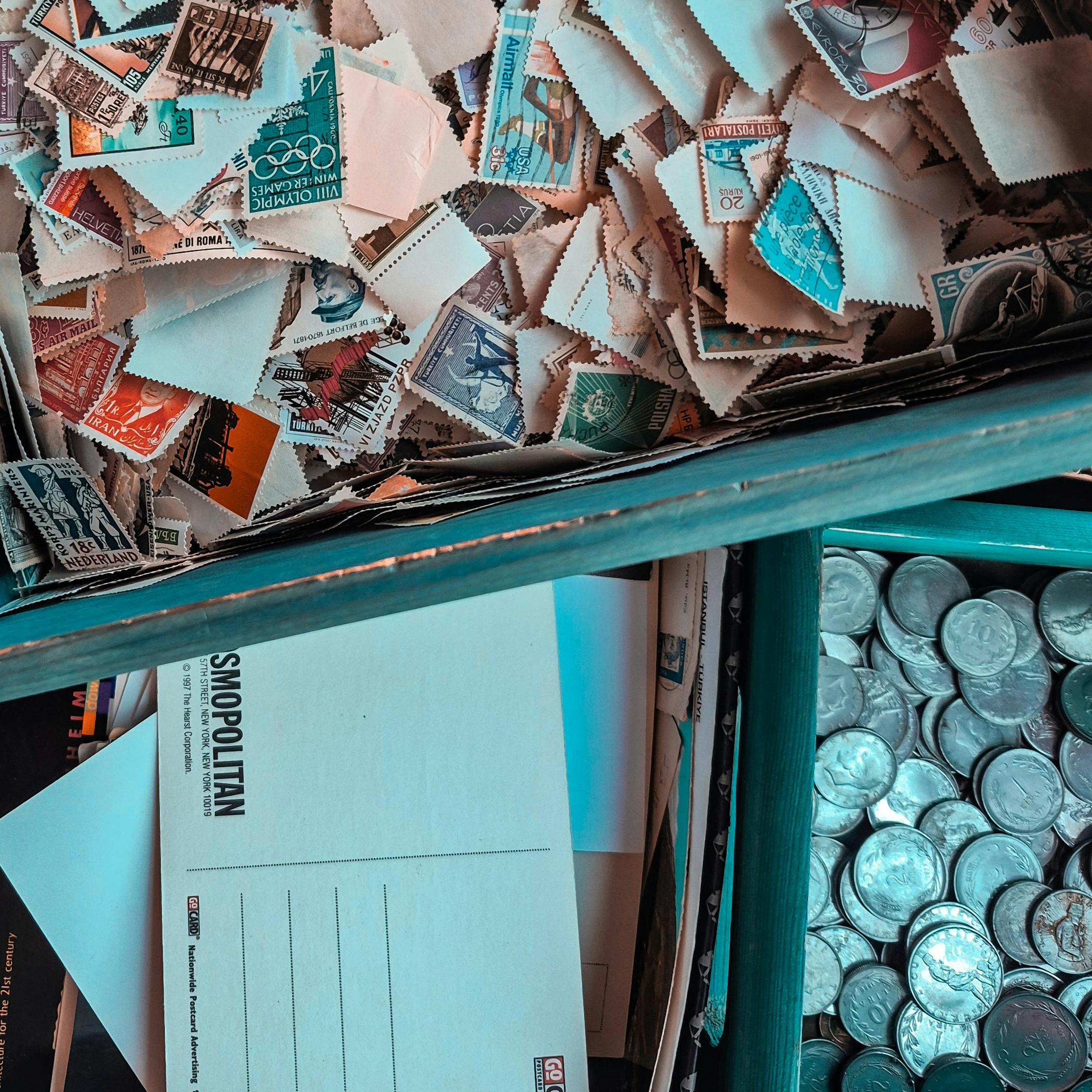
    The same applies to fossils, stamps, coins, model trains, vintage computers, or whatever flavour of obsession has currently attached itself to the brain.

    What often fascinates us isn’t simply the object itself but the system surrounding it.

    The classifications.

    The subtle differences.

    The exceptions to the rules.

    The one obscure variation that only three people on Earth appear to care about.

    Most people look at a shelf and see “a collection”.

    A pattern-seeking brain looks at the same shelf and sees a map.

    Every object has a place. Every category has a purpose. Every missing item creates a tiny itch in the back of the mind that quietly whispers:

    “You know exactly what’s supposed to go there.”

    The collection becomes more than a pile of things. It becomes a system to explore, understand and occasionally obsess over.

    And for brains that derive genuine pleasure from finding order amidst chaos, that’s immensely satisfying.

    Of course, collections aren’t just about categorisation and pattern-seeking. If they were, a spreadsheet would be every collector’s dream and nobody has ever become emotionally attached to a spreadsheet.

    Well… almost nobody. :embarrassed smiley:

    Over time, collections become something more than the objects themselves.

    A favourite book isn’t merely paper, ink and glue. A battered old slide rule isn’t simply a calculating device. A particular Rubik’s Cube isn’t just coloured plastic.

    They become markers in the timeline of our lives.

    Some remind us of places we’ve been.

    Others remind us of people we’ve known.

    Some represent achievements, discoveries or periods when life felt particularly good.

    Others survived difficult times and somehow became associated with comfort, familiarity and stability.

    For many neurodivergent people, objects can provide a reassuring sense of permanence in a world that often feels unpredictable.

    People change.

    Jobs change.

    Circumstances change.

    Favourite television programmes get cancelled.

    Entire social media platforms appear, dominate the internet for five years and then vanish into obscurity.

    But that slightly battered book you’ve owned for twenty years?

    It’s still there.

    That curious fossil sitting on the shelf?

    Still there.

    The collection remains a small constant in an ever-changing world.

    Objects also possess several advantages over people.

    They don’t judge your interests.

    They don’t suddenly decide they no longer like you.

    They don’t require careful interpretation of facial expressions, body language or implied meanings hidden beneath three layers of social convention.

    Most importantly, they don’t initiate small talk.

    I’ve yet to encounter a slide rule that felt compelled to discuss the weather.

    A collection is predictable. It has structure. It behaves according to understandable rules. You know where things belong and what purpose they serve.

    In a world that can sometimes feel noisy, confusing and chaotic, there is something deeply comforting about that.

    Perhaps that’s why collections often become emotional anchors.

    They’re not merely accumulations of objects.

    They’re accumulations of memories, interests, experiences and fragments of identity.

    They’re little pieces of ourselves arranged neatly on shelves.

    The Dopamine Hunt

    Then there’s the dopamine hunt.

    If autism often provides the catalogue, ADHD frequently supplies the expedition.

    For many collectors, the real excitement isn’t owning the item.

    It’s finding it.

    The search itself becomes the hobby.

    Tracking down a rare edition.

    Discovering an obscure variant.

    Learning some wonderfully unnecessary fact about a manufacturing change made in 1973.

    Completing a set that has been taunting you for years.

    It’s part treasure hunt, part side gather quest and part Pokémon for adults with back pain.

    An ADHD brain can derive astonishing amounts of happiness from locating a very specific obscure object that nobody else on Earth appears to care about.

    Hours of searching, weeks of waiting and countless dead ends can all evaporate the moment the target is finally acquired.

    Of course, this creates a slight problem.

    The dopamine was never entirely in the object.

    It was in the chase.

    Which explains why collectors are often found muttering the dangerous phrase:

    “I’m only looking…”

    Right before accidentally acquiring three more items for the collection.

    Some Collections Are Apparently More Respectable Than Others

    One of the more fascinating quirks of society is that some collections are considered sophisticated while others are considered evidence that you should perhaps be supervised more closely.

    Collect vintage wines and you’re a connoisseur.

    Collect rare watches and you’re an investor.

    Assemble a garage full of classic cars and people nod approvingly while using words like heritage and craftsmanship.

    Collect Rubik’s Cubes, slide rules or obscure retro clothing and suddenly you’re “that bloke with all the cubes” or “that fat prat in the cravat”.

    The strange thing is that the underlying behaviour is often identical.

    In both cases someone is spending considerable amounts of money acquiring objects they don’t strictly need, learning unnecessary amounts of information about them and becoming disproportionately excited when they discover a rare variant.

    Apparently spending £10,000 on a watch is a sensible investment.

    Spending £10 on a forty-year-old slide rule is a cry for help.

    I remain unconvinced by this distinction.

    The Danger Zone

    Of course, like most things that bring us comfort and enjoyment, collecting can occasionally wander into less healthy territory.

    A collection can become clutter if it grows faster than our ability to manage it.

    The thrill of acquisition can become an expensive habit.

    The search for the next item can sometimes become more important than appreciating the things we already have.

    For some people, collections can also become a form of avoidance; a way of retreating into a familiar and controllable world when life outside feels difficult, uncertain or overwhelming.

    There’s nothing inherently wrong with any of this.

    Most hobbies have their excesses.

    The trick, as with so many things, is balance.

    A collection should enrich your life, not consume it.

    It should be a source of joy, curiosity and comfort rather than stress, debt or obligation.

    After all, if your collection starts requiring its own collection to keep track of it, it may be time for a quiet sit-down and a cup of tea.

    Physical Objects in a Digital Age

    In an increasingly digital world, I sometimes wonder whether part of the appeal of collections is simply that they are real.

    So much of modern life exists behind glass screens.

    Books become files.

    Music becomes subscriptions.

    Photographs become pixels.

    Entire friendships can be reduced to a collection of messages stored on somebody else’s server.

    There’s nothing inherently wrong with any of that. The digital world has given us remarkable things.

    But digital experiences can sometimes feel strangely weightless.

    A physical object occupies space in the world.

    A book has weight in your hands.

    A fossil connects you to a creature that lived millions of years before the first human wondered where they left their keys.

    A slide rule carries the fingerprints of the engineers, scientists and students who once used it to understand the universe.

    These things have history.

    They’ve travelled through time.

    They existed before you discovered them and, with a little care, they’ll probably continue to exist long after you’re gone.

    Perhaps that’s part of what makes them meaningful.

    When I hold an old slide rule, I’m not simply looking at an obsolete calculating device.

    I’m holding a small piece of human ingenuity.

    A reminder that generations of curious people spent their lives trying to understand the world around them.

    In that sense, collections aren’t really about ownership.

    They’re about stewardship.

    For a little while, these objects become part of our story.

    Then one day they’ll become part of someone else’s.

    There’s something rather comforting about that.

    In Closing

    So yes, perhaps neurodivergent people do collect unusual things.

    But maybe that is because we notice unusual beauty.

    Maybe we find joy in patterns other people overlook, or comfort in systems that make sense to us, or delight in a slightly odd shelf of interesting nonsense that happens to look brilliant in our own particular internal lighting.

    Or maybe we just like collecting things that make us happy and occasionally confuse visitors.

    Honestly, it is probably all of the above.

    And really, that seems like a perfectly reasonable way to spend a life.