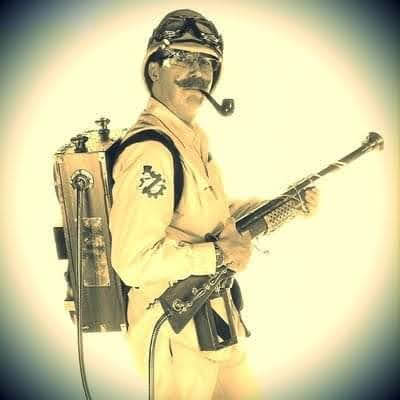
(Or: How Dressing as a Victorian Ghostbuster Became the Most Authentic Version of Me.)
I’ve spent most of my life pretending to be somebody else.
Every day I slip into the role of a “fully functioning adult”, whatever that’s supposed to be. I mask, I moderate my behaviour, I soften the rougher edges of my personality and generally do my best impression of somebody who has absolutely everything under control.
At weekends, however, the mask begins to slip. I’m far closer to my authentic self and considerably less restrained by the image I’m expected to project in the office. That isn’t to say I suddenly become a different person. It’s more that I stop spending quite so much energy trying to look like everybody else.
Masking takes a tremendous amount of mental effort. It’s one of the biggest contributors to the autistic burnout I’ve written about previously, which is probably why people find it rather odd when I tell them one of my favourite hobbies involves dressing up as a Victorian Ghostbuster.
Surely, if I spend all week performing one role, the last thing I’d want to do for fun is perform another?
Well… not quite.
My Everyday Performance
I’ve written before about masking, about my “stage voice” developed to hide my stammer, and about the burnout that often follows from constantly monitoring my behaviour. I won’t repeat all of that here, but it essentially boils down to one simple observation.
To some extent, Everyday Pete is a carefully rehearsed performance.
I monitor how loudly I’m speaking and pay attention to my body language. I’ll try to maintain the right amount of eye contact. I avoid wandering too far down conversational rabbit holes, no matter how desperately I want to explain why TCP handshaking is the perfect analogy for small talk or why slide rules are infinitely more interesting than calculators.
It’s a performance I’ve become very good at.
It’s also exhausting.
Enter the Ghostbuster
You’d therefore think that taking this daily performance and turning the dial up to eleven would be the last thing I’d choose to do for enjoyment.
Oddly enough, the exact opposite is true.
Before I explain why, let me introduce the character.
Not the costume.
The personality.
He’s confident, bombastic, friendly, outgoing, slightly pompous, and considerably larger than life. He’ll happily wander up to complete strangers, pose for photographs, chat to children about ghosts, and generally behave as though the world is one enormous stage.
In other words, he’s the sort of chap who cheerfully says hello to strangers.
I generally hope strangers haven’t noticed me.
Even his name is rather revealing.
He’s called Professor Mycroft Spengler, which, if you’re familiar with my literary and cinematic tastes, tells you almost everything you need to know about me.
He’s a shameless fusion of Mycroft Holmes and Egon Spengler.
Mycroft Holmes is hyper-intelligent, analytical, quietly formidable, happiest solving problems rather than socialising, and far more comfortable working behind the scenes than standing in the spotlight.
Egon Spengler is a scientist, collector of obscure knowledge, enthusiast of spores, moulds and fungi, socially awkward, endlessly curious, and gloriously unconcerned with appearing “normal”.
Neither of them are conventional action heroes.
Nor are they particularly charismatic.
Neither are especially loud.
So naturally my subconscious looked at those two characters and thought:
“Yes… let’s combine them.”
Apparently, given complete creative freedom, my brain built a character whose defining qualities are intelligence, curiosity, scientific obsession, and spectacular social awkwardness…
…and then gave him brass goggles and a wooden proton pack.
When I stop and think about it, that probably says something important about my personality!
The Tax
Let’s clear one thing up, though.
For years Comic Con terrified me. I’d travel all the way there, reach the entrance, see the crowds stretching off into the distance and quietly turn around and go home. On the occasions I did make it inside, I’d often become overwhelmed within twenty minutes and leave feeling thoroughly dejected.
Mycroft changed that.
He’s become a form of armour. Not armour that hides me, but armour that allows me to function in an environment that would otherwise overwhelm me. He gives me a role to play, a script to follow and, perhaps most importantly, permission to interact with people in ways that everyday Pete would normally avoid. I no longer worry about whether I should talk to strangers because, quite frankly, that’s exactly what a Victorian Ghostbuster ought to be doing.
It works.
I can never manage more than one day at a convention because afterwards I have to pay the bill I’ve quietly been running up. I’ve hyper-masked for most of the day. I’ve spoken to hundreds of people, posed for countless photographs, answered questions, smiled, joked, improvised, stayed in character and absorbed the noise, lights, crowds and sheer intensity of the event. By the time I get home my social battery isn’t merely low, it’s running on fumes.
The following day I usually disappear. I’ll spend it quietly reading, listening to music, tinkering in the workshop or simply enjoying the blissful absence of people. Not because I didn’t enjoy Comic Con. Quite the opposite. I loved every minute of it. I’m simply paying yesterday’s invoice. It’s worth every penny, but it’s an expensive hobby in ways most people never see.
The Subtle Difference
I should probably correct myself slightly because calling cosplay a form of masking isn’t entirely accurate. It’s a useful analogy, particularly as I’m technically wearing a physical mask of one sort or another, but the two things are fundamentally different.
Masking, at least for me, is about hiding parts of myself. I minimise my differences, smooth away the rough edges and quietly blend into the background. The aim is to become less noticeable, less awkward and, if I’m honest, a little more forgettable.
Cosplay does exactly the opposite.
Instead of hiding my differences, it exaggerates them. It takes my enthusiasm, curiosity, theatricality and love of the absurd and turns the volume right up. It’s the difference between whispering and standing on a table shouting:
“THIS IS ME. I’M WEIRD, AND I’M PERFECTLY HAPPY ABOUT IT.”
There’s something wonderfully liberating about that.
Why Ghostbusters? Why Steampunk?
People occasionally ask why I chose Ghostbusters.
My usual answer is simply:
“Why not?”
Ghostbusters has always been one of my favourite film franchises because, when I stop and think about it, none of the characters are conventional heroes. Ray Stantz is wonderfully enthusiastic and endlessly curious. Egon Spengler is socially awkward, intellectually brilliant and entirely unconcerned with appearing “normal”. Peter Venkman presents himself as confident and charismatic, but I’ve always suspected the sarcasm and bravado are simply another form of armour. Whenever life becomes complicated, he deflects it with humour.
They’re not superheroes.
They’re underdogs who accidentally become heroes.
I find that strangely reassuring.
Steampunk satisfies a completely different part of my personality. If you’ve read my article about museums you’ll already know I have an enduring fascination with discovery, invention and curiosity. The Victorian and Edwardian periods were full of people pushing at the boundaries of science and engineering, trying to understand how the world worked and asking, “What if?”
Now, before the historians reach for their keyboards, I’m well aware that Victorian Britain had more than its fair share of problems. Steampunk isn’t history. It’s alternative history, a world where Babbage’s Difference Engine really did work, where Jules Verne reached the Moon. A fantasy world where Wells and Poe somehow became engineers instead of novelists. It’s a world of steam-powered computers, impossible inventions and outrageous imagination, but without the poverty, colonialism, misogyny and social inequality that accompanied the real Victorian era.
Put Ghostbusters and Steampunk together, add a dash of amateur dramatics and an unhealthy enthusiasm for brass and mahogany panelling, and out walked Professor Mycroft Spengler.
In Closing
The funny thing is that my Ghostbuster costume isn’t really hiding who I am. It’s revealing parts of me that everyday life quietly encourages me to keep folded away. He’s louder than I am, more confident than I am, and considerably more theatrical than I am, but none of those qualities are fake. They’re all me.
Just with a proton pack.
Eventually the goggles come off, the proton pack goes back on its stand and Mycroft quietly disappears until the next convention. The exhaustion arrives shortly afterwards and, as always, the masking tax has to be paid. For a few glorious hours, though, pretending to be somebody else allows me to stop pretending to be somebody I’m not.
That’s a trade I’ll happily keep making.