Tag: curiosity

  • The Wondrous View from the Top of Mount Stupid

    The Wondrous View from the Top of Mount Stupid

    We All Start Somewhere

    Although it may be hard to believe, I wasn’t born a mathematician. I wasn’t gifted thirty-plus years of software development experience the moment I took my first breath on this large, strange planet outside my mother’s womb. Just like everyone else, I had to learn. I had to learn numbers, the alphabet, and how to manipulate fiendishly complicated things… like shoelaces and buttons. My brain was plastic and malleable. It soaked up new knowledge like a sponge.

    Then, of course, one day I knew EVERYTHING!

    At least, I thought I did.

    In reality, all I’d done was climb the north slope of Mount Stupid.

    It’s OK. I’ve stood there, and I’ll confidently say that you probably have too. In fact, I’d go so far as to say that every one of us has stood on that summit at some point in our lives, breathed in the rarefied air, looked out over the vast landscape ahead and suddenly realised just how much more there was still to learn.

    “Oh…”

    Actually, I’m here to tell you that the view from the summit isn’t depressing.

    It’s breathtaking.

    Not just because of the thin air, not because of what lies beneath you, but because of what lies beyond.

    The Internet Gets Dunning–Kruger Wrong

    An idea originally published as the Dunning–Kruger effect has, sadly, been adopted by the internet and transformed into the meme-worthy “Why Do Dumb People Think They’re Smart?” Usually it’s written with an irritating mixture of upper and lower case letters, “mUcH lIkE ThIs”, to convey a sense of superiority over people who simply haven’t yet learned enough to realise how much they still have to learn.

    I don’t like that interpretation.

    It’s cruel, and it mocks people who simply haven’t yet reached the point where the world suddenly opens up in front of them. I’d argue that every one of us has to climb Mount Stupid before sliding down the far side into the so-called Valley of Despair. That’s simply part of learning.

    Making fun of somebody for standing on Mount Stupid is rather like mocking a toddler for proudly taking their first steps because they can’t yet run a marathon or land a perfect triple-twisting backflip.

    Go on.

    Google “Dunning–Kruger”.

    See how many articles contain words like idiot, stupid, moron, or dumb.

    As I’ve already said, none of us are born with the knowledge and skills we possess today.

    It’s a journey we all take.

    The View Gets Better

    I have stood at the top of this mountain.

    The brief excitement of thinking I’d reached the summit quickly gave way to the realisation that I’d merely climbed the first hill in an entire mountain range. At first that’s a sobering thought, but once I realised just how much there still was waiting to be discovered, the journey became exciting rather than intimidating.

    Oddly enough, the further I’ve travelled from the summit of Mount Stupid, the less certain I’ve become. Thirty-plus years into software development I’m far more comfortable saying, “I don’t know,” than I ever was after my first year.

    The mountain didn’t make me arrogant.

    The rest of the journey made me humble.

    These days I’m genuinely delighted when somebody shows me something new. I’ve learned far more from making mistakes than I ever have from getting things right the first time. I don’t see those moments as failures of intelligence. I see them as opportunities to expand my understanding of the world.

    The Valley of Despair

    Unfortunately, this is also the point where imposter syndrome quietly creeps into the conversation.

    After more than thirty years in software it’s remarkably easy to think:

    “Who am I kidding? I know nothing.”

    But that’s simply untrue.

    There’s a profound difference between knowing nothing and not knowing everything.

    The first is ignorance.

    The second is simply the natural consequence of continuing to learn.

    The Valley of Despair isn’t merely the moment when I realise I know less than I thought.

    It’s the moment I start believing I’ll never know enough.

    That’s where many people quietly abandon a hobby, a career, or a subject they’ve genuinely fallen in love with. They mistake the size of the journey for evidence that they aren’t capable of completing it, when in reality they’ve simply reached the point where genuine learning begins.

    Sometimes pushing through that valley is hard.

    I’ll freely admit that I’ve occasionally turned around.

    I’ve started new hobbies, enthusiastically bought the books, the equipment and all the shiny new gadgets, learned everything I could as a beginner and then, with growing horror, realised just how much mountain still lay ahead of me.

    At that point I’ve quietly muttered:

    “No… perhaps this isn’t for me after all.”

    And turned around.

    Sadly, I’ve done that rather more often than I’d like.

    AuDHD doesn’t exactly help.

    Looking back, though, I’m grateful I climbed Mount Stupid.

    The view really was wonderful.

    Not because I could finally see how much I knew, but because, for the first time, I could see just how astonishingly much there still was waiting to be discovered.

    I rather hope I never reach the end of that journey.

    One Final Irony

    Of course, before somebody points it out…

    There’s a delicious irony in writing an article explaining the Dunning–Kruger effect.

    It immediately raises the uncomfortable question of whether I’m demonstrating the very phenomenon I’m attempting to describe.

    Fortunately I’ve spent enough years studying mathematics and software engineering to know, with absolute certainty, that I understand almost nothing.

    Which, oddly enough, is probably the closest thing to a qualification I have for writing this article.

  • Why I Love Museums.

    Why I Love Museums.

    I have yet to visit a museum I didn’t like.

    Some have been better than others, certainly, but I have never walked out of one thinking, “Well, that was a disappointing collection of fascinating things.”

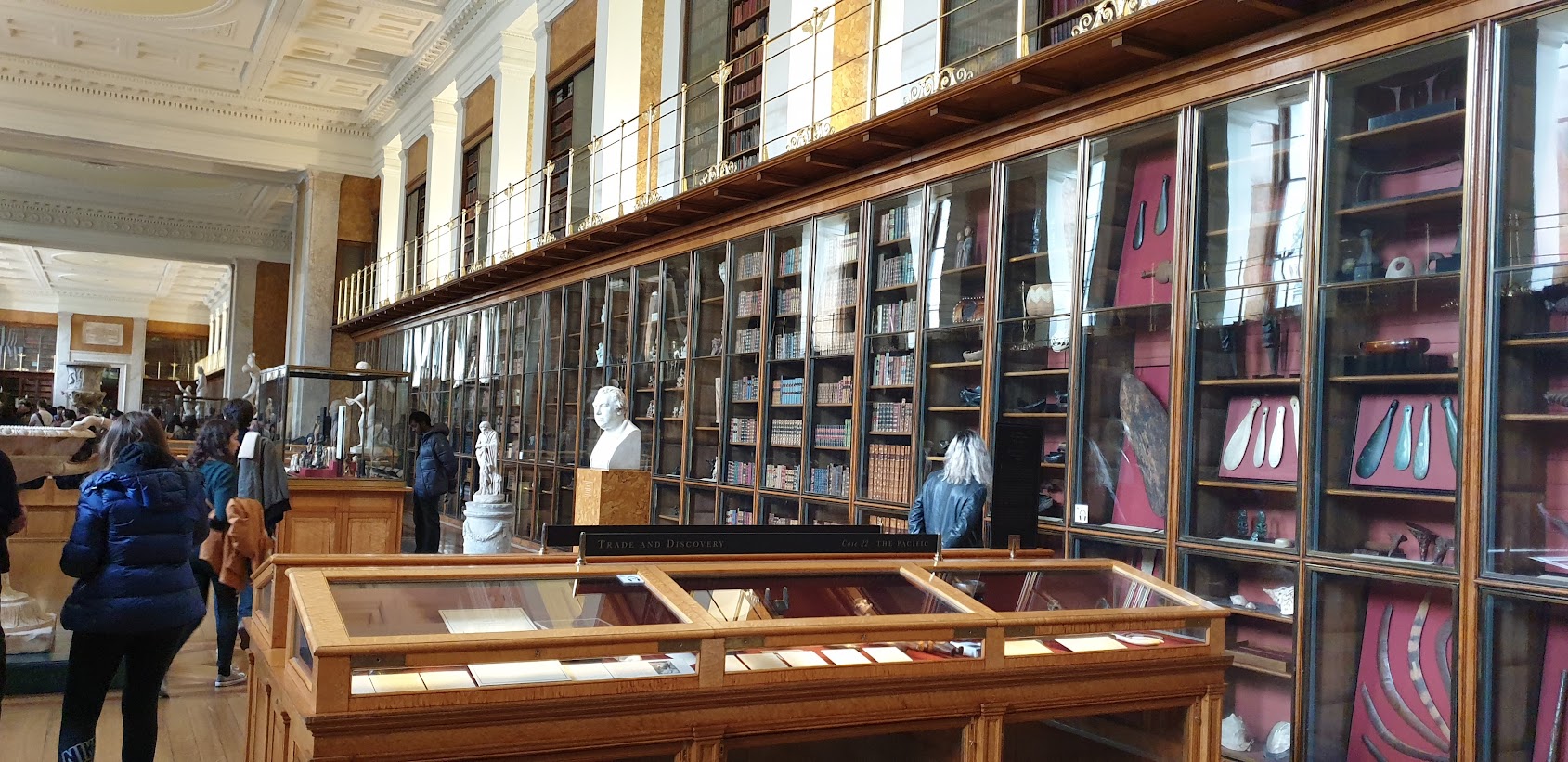
    Large or small, broad or niche, I love museums. When I’m in London they’re some of my favourite places to spend time, and in London we’re really spoiled for choice. Clustered together in South Kensington you’ve got the V&A, the Natural History Museum, and, just around the corner, the Science Museum. Up in Bloomsbury there’s the OG GOAT, the British Museum, containing some of the very best purloined and, ahem… “enthusiastically acquired” artefacts from the four corners of the globe. (Hey, let’s not get political here. – Ed.)

    Further afield there’s the National Maritime Museum in Greenwich, and not forgetting my old stomping ground, the Horniman Museum in Forest Hill, complete with its famously overstuffed walrus.

    Those are just a few of my regular haunts.

    I don’t really go to museums to “learn” in the formal sense. I go because they’re one of the few places left where curiosity doesn’t need to justify itself. Nobody asks what you’re going to do with the information you’ve just discovered. Nobody expects it to improve your productivity or advance your career. Sometimes it’s enough simply to stand in front of an object and think, “Well… that’s fascinating.”

    I can happily spend hours wandering around a museum on my own. Not only do I find them endlessly fascinating, but they’re also havens of calm, quiet, and peace. Unlike the busy, bustling streets or shopping centres, nobody has ever stood next to me in a museum shouting into their mobile phone about printer cartridges.

    Well… not usually.

    There’s always the annoying exception.

    Museums Are Libraries for Things

    Books preserve ideas and knowledge.

    They also preserve some truly dreadful plots, improbable narratives, and larger-than-life characters, but I digress.

    Museums preserve objects.

    Every exhibit has a story.

    Every exhibit has a history.

    Every exhibit has a purpose.

    Every exhibit has a journey.

    A Roman coin isn’t just a coin. It may have been somebody’s wages. It may have paid for a meal, a night’s lodging, or a particularly good mug of mead. Perhaps it was dropped and lost in the mud, or perhaps somebody carefully buried it for safekeeping and never returned.

    A steam engine isn’t just a collection of iron and brass. It represents the Industrial Revolution in miniature. It may have pumped water from a mine, powered a textile mill, or hauled ore from Cornwall to London while quietly transforming the world around it.

    Objects are never just “things”.

    They’re tiny windows into somebody else’s life.

    I’ve often thought that museums are what happen when humanity collectively decides, “We probably shouldn’t throw this away. It might be important later.”

    In many respects, a museum is simply a much larger, considerably better organised version of every family’s junk drawer.

    The difference is that somebody has already rummaged through the drawer and decided which objects tell the best stories. Museums don’t really preserve things. They preserve curiosity. Every display case is an invitation to ask, “Who made this?”, “Why did they make it?”, and “What was life like for the person who used it?” I don’t always need the answers. Sometimes the questions are the interesting part.

    Curiosity Without Purpose

    Modern life sends us some rather contradictory messages.

    On the one hand we’re expected to keep up with the latest technology, the newest trends, and whatever today’s fashionable productivity hack happens to be. On the other, we’re encouraged to own less, declutter our lives, and throw away anything that doesn’t “spark joy”.

    The trouble is, in my case, almost everything sparks joy.

    Museums quietly reject the entire premise.

    Modern life constantly asks:

    “What’s the point?”

    Museums simply reply:

    “Because it’s interesting.”

    And, for me at least, that’s more than enough.

    I can happily spend twenty minutes studying a fossil, a Viking comb, or a display of Victorian kitchen utensils. Not because they’ll help me earn more money or make my day-to-day life more efficient, but because they’re fascinating. Sometimes they’re educational. Sometimes they’re beautiful. Often they’re all of the above.

    The Peace and Quiet Is Underrated

    One of the things I appreciate most about museums is something people rarely mention.

    They’re quiet.

    They’re orderly.

    They’re predictable.

    There’s an almost reverential atmosphere about them. People naturally lower their voices, slow down, and actually pay attention to what’s around them.

    For me, that’s the complete opposite of a shopping centre.

    Shopping centres are frenetic, noisy, crowded, brightly lit, and full of people apparently engaged in some sort of competitive speed-walking event. I find them exhausting.

    Museums have the opposite effect.

    They calm me down.

    They centre me.

    I’ve quite happily spent the best part of an entire day in a museum, especially if it has a decent café and an excellent bookshop attached.

    Every Object Has a Story

    The larger museums cover an astonishing breadth of human experience. One minute I’m looking at Egyptian artefacts thousands of years old, the next I’m staring at inventions from the late twentieth century.

    There’s something distinctly unsettling about visiting a museum to look at ancient history and suddenly finding the exact same Trimphone your parents had sitting proudly behind glass.

    As I’ve mentioned in previous posts, I’m something of a collector myself. I have numerous collections of things I find interesting, quirky, or simply too fascinating to leave behind.

    Museums do exactly the same thing.

    Just on a considerably larger scale.

    Every object once belonged to somebody.

    Somebody designed it, made it, used it, valued it, then sadly lost it.

    Then, somehow, it ended up behind glass because somebody else recognised that it was worth preserving.

    There’s something deeply human about that.

    Whenever I visit a museum I find myself thinking less about the objects themselves and more about the people behind them. Someone sat at a workbench and made this, carried it, repaired it when it broke. And then much later someone else decided it was too important to throw away. Long after they’ve gone, a small part of their life survives behind a sheet of glass, quietly telling its story to complete strangers. I find that oddly comforting.

    We Preserve What We Value

    Museums aren’t simply rooms full of old “stuff”.

    Because every museum is curated, every museum accidentally reveals what a society believes is worth remembering.

    Sometimes that’s kings, queens, great battles, famous paintings, or technological breakthroughs.

    Sometimes it’s kitchen utensils, railway tickets, children’s toys, wine goblets, or obscure calculating devices.

    If I’m honest, it’s often the ordinary objects that fascinate me the most.

    Civilisation wasn’t built solely by kings and generals.

    It was built day by day by ordinary people.

    People who packed lunches.

    People who worried about warm clothing.

    People who needed decent shoes.

    People who wrote shopping lists on clay tablets and prayed to pantheons of strange gods.

    Those are the people I find myself wondering about.

    Permission to Wonder

    This is probably my favourite reason for loving museums.

    Somewhere along the line many adults stop asking, “What does this do?” or “Why does it work that way?”

    We lose something of our childlike curiosity.

    Museums quietly encourage exactly the opposite.

    In fact, they almost insist upon it. They invite adults to behave like children again, in the very best sense of the word. To point at things. To ask daft questions. To become excited by a beautifully engineered clock, a dinosaur skeleton, or a collection of eighteenth-century spoons that nobody has thought about for two hundred years. Curiosity, after all, isn’t childish. It’s one of the most profoundly human qualities we possess.

    Every display case seems to say:

    “Go on. Be curious. Ask questions. That’s what I’m here for.”

    If you ask me, and seeing as you’re reading my blog I’ll assume you do, that’s rather lovely.

    My Perfect Day

    My perfect museum visit involves wandering around without a map.

    I don’t think of it as aimless wandering.

    I prefer to call it exploring.

    I’ll spend far too long reading information boards, become unexpectedly fascinated by a single fossil, discover something I didn’t even know existed, and then inevitably wander into the gift shop.

    There I’ll buy a book.

    Then another book.

    Perhaps a T-shirt.

    Then realise I’ve bought too much and purchase a tote bag to carry everything.

    At which point I’ll probably buy another book because, well, I’m already there.

    I may as well make the most of it.

    The museum gift shop is where my wallet quietly resigns itself to the inevitable.

    Closing Thoughts

    Perhaps that’s why I love museums so much.

    They aren’t really buildings full of old objects.

    They’re quiet celebrations of human curiosity.

    Every display case says:

    “This mattered.”

    “Somebody made this.”

    “Somebody discovered this.”

    “Somebody thought this was worth keeping.”

    In a world obsessed with the newest thing, museums gently remind me that old things still have stories to tell, and that knowledge doesn’t need to earn its keep to have value.

    More than anything else, museums give me permission to remain curious. To keep asking questions. To keep learning. To keep wondering how things work and why people made them in the first place.

    Growing older shouldn’t mean becoming less curious.

    If anything, I rather hope it means becoming more so.

    Besides…

    Where else can I spend an afternoon looking at medieval surgical instruments, Roman pottery, steam engines, dinosaur skeletons and an alarmingly overstuffed walrus without anybody questioning my life choices?

  • The Internet Was More Interesting Before Everything Became a Platform

    The Internet Was More Interesting Before Everything Became a Platform

    I remember the early days of the internet.

    I remember the terrible websites with flashing green text on red backgrounds, animated GIFs in abundance, JavaScript visitor counters at the bottom of the page, MIDI tunes that started playing when you accessed the site, and entire websites dedicated to someone’s hamster.

    (Guilty as charged, m’lud.)

    And you know what?

    It was GLORIOUS!

    Don’t worry, this isn’t an “old man yells at cloud infrastructure” post.

    The old internet wasn’t perfect, it wasn’t ideal, and it certainly wasn’t always safe.

    However, what it was, was quintessentially human.

    THE INTERNET USED TO FEEL GEOGRAPHICAL

    The actual internet was a highway.

    It wasn’t the destination, but the means of travelling between weird towns, villages, and hamlets, each of which specialised in… well… something.

    Much like the towns in the Mad Max universe, where you have Bartertown, Gastown, Bullet Farm, and Tomorrow-morrow Land, the internet had Hamsterville, Catopolis, Conspiracy Creek, and Anosmia Acres.

    I was a serial website owner.

    I ran an anosmia support forum which, somehow, got me on television for my fifteen minutes of fame.

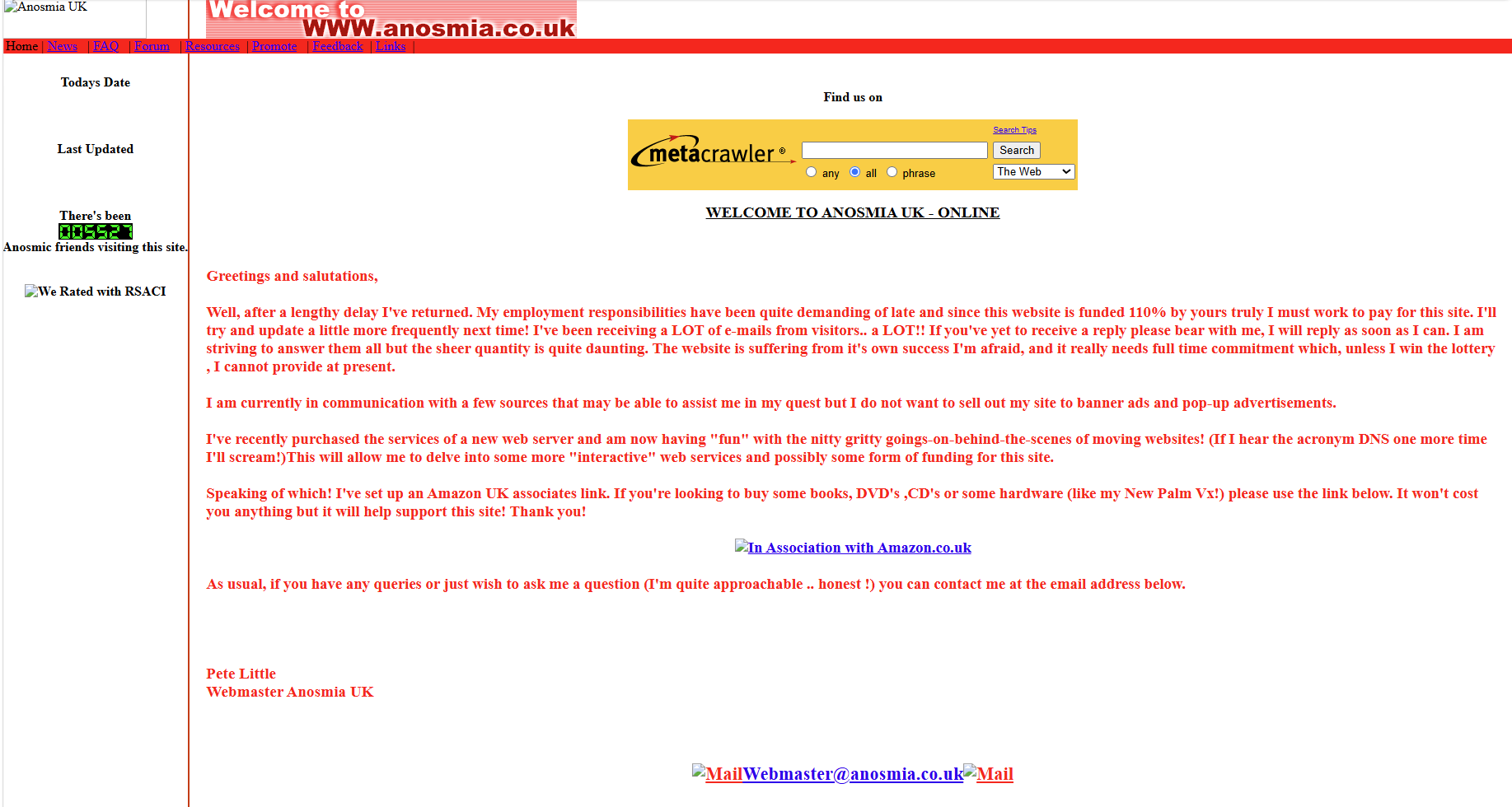
    Its design may well have made visitors’ eyes bleed, granted, but as it was a support group for people with no sense of smell, it was perhaps appropriate that my design stank. (See featured image from The Internet archive above!)

    I ran a joke conspiracy PHPBB forum called the UK Conspiracy Nexus, where every “member” was another character I had created and all the posts, arguments, and discussions were written by me.

    I deliberately invented ridiculous conspiracy theories, such as the connection between Toblerone and Illuminati mind-control dentistry.

    It’s the triangular shape, you see.

    It was all good fun… until I noticed my posts being shared non-ironically on more “serious” conspiracy sites.

    Dear God.

    What did I spawn?

    I also created a maths and general nerdiness site dedicated to things geeks might find “sexy” (that is to say, cool).

    In hindsight, calling it Sex4Geeks was perhaps inviting exactly the sort of dubious attention it received.

    That site was short-lived.

    It did, however, end up becoming a joke in my best man’s wedding speech.

    Pete?

    Naive much?

    Heck yes.

    But the internet was full of things like this.

    BBSs.

    Usenet.

    Forums.

    IRC.

    Personal webpages written in hand-crafted HTML.

    It wasn’t one place.

    It was thousands of interconnected little places, each with their own personality, culture, and rules.

    You didn’t live there.

    You visited.

    You travelled between them.

    You discovered them.

    You got lost.

    Wonderfully so.

    NOBODY NEEDED A BUSINESS PLAN

    The majority of the internet back then existed for one reason.

    Someone cared about something enough to make something about it.

    Not because they wanted followers, subscribers, sponsorships, or monetisation.

    It was because somebody cared enough about model railways, their collection of Tamagotchis, or the history of the China tea trade.

    They had passion and they wanted to share it.

    There was a website for every niche interest and most of them looked as though they had been assembled during an environmental catastrophe and built entirely in the dark.

    THE GREAT CONSOLIDATION

    Of course, initially seen as a fad, the internet proved it wasn’t going anywhere.

    People realised its potential.

    You could now order a pizza online.

    Such a technological breakthrough is something we take entirely for granted nowadays.

    Companies with ideas and dollar signs in their eyes jumped in.

    Slowly, giants emerged from the chaos.

    Where once there had been millions of random amateur websites, suddenly you had Facebook, Twitter, and MySpace.

    Then YouTube, Reddit, Instagram, and TikTok.

    These places acted like magnets, drawing in the weird from the satellite towns, villages, and hamlets, and housing them instead in vast digital metropolises.

    THE ALGORITHMS THAT ATE DISCOVERY

    Finding things used to be an adventure.

    There were a few basic search engines, reciprocal links, blogrolls, and web rings connecting like-minded sites together.

    You would wander around them feeling as though you were forging your own path through a strange and fascinating landscape.

    You discovered what people made.

    You sought out things that interested you.

    Now we no longer discover what people made.

    We discover what the algorithms, working on behalf of the platforms, want us to see.

    Want your site to appear first in search results?

    Just pay lots of money.

    It’s even worse now with AI-generated summaries appearing above the sites that originally created the content.

    In the pursuit of making things easier, we lost something human along the way.

    THE DEATH OF WEIRD

    The old internet was eccentric, amateur, and personal.

    Websites now look polished, optimised, branded, and laden with “smart” features.

    The old internet may have looked like a terrible hodgepodge mess, but it looked like somebody.

    It was human.

    Much of today’s internet looks like a corporation.

    A polished, focus-grouped, metrics-driven corporation.

    A CONFESSION

    Nostalgia is a terrible historian.

    As Baz Luhrmann famously said:

    “Nostalgia is a way of fishing the past from the disposal, wiping it off, painting over the ugly parts, and recycling it for more than it’s worth.”

    The old internet had its fair share of problems.

    Awful design.

    Scams.

    Misinformation.

    Toxicity.

    Every village conspiracy nut could find a like-minded community and build little echo chambers where the worst ideas fed off one another and grew.

    I’m not arguing that the old internet was perfect.

    I’m simply saying it was more human.

    We still have scams, misinformation, and toxicity.

    Now it’s just run by a handful of billionaire puppet masters.

    WE LOST MORE THAN WEBSITES

    The real loss wasn’t the technology.

    That grew.

    Who would have imagined we’d one day carry around access to the sum total of human knowledge on a small device that fits in the palm of our hand?

    We lost individuality.

    Experimentation.

    Curiosity.

    And yes, weirdness.

    The internet became a consumer space for selling content rather than a creative space for sharing ideas.

    IN CONCLUSION

    Perhaps that’s one of the reasons I reincarnated this blog.

    Not because I expect thousands of readers.

    Not because I have a monetisation strategy.

    Not because some marketing consultant told me to build my personal brand.

    No.

    Because I miss people having little corners of the internet that belonged to them.

    Places where we could be knowledgeable, enthusiastic, eccentric, or even completely wrong about something.

    Places that felt human.

    The internet may have become a platform, but there’s still room for the occasional strange little website.

    Or should I say, in my case, the occasional strange Little website.

    This is my own weird nest on the web.

  • Why Neurodivergent People Often Become Collectors

    Why Neurodivergent People Often Become Collectors

    I sit here in my home office, surrounded by many little boxes, each containing a strange assortment of items.

    If you’ve read my About Pete page (or followed me here from my Mastodon profile), you’ll know I am a collector of collections. Not content with collecting just one type of thing, I somehow ended up collecting multiple collections. So much so that my collections have effectively become a collection in their own right.

    A collection squared, if you will.

    How did this happen?

    More importantly, why did this happen?

    I used to simply pick up things I found interesting. At some point I realised I didn’t merely “own some things”. I had somehow become the curator of a growing museum dedicated to obscure enthusiasm.

    Slide rules. Rubik’s Cubes. Cravats. Books. Albums and CDs. Fossils and minerals. Obsolete retro technology. Raspberry Pis.

    Left unsupervised long enough, I would probably begin alphabetising pebbles or categorising sawdust!

    What is it about collecting that I find so satisfying? What part of me does it appease? What itch does it scratch?

    Speaking as an autistic person, I know from first-hand experience that neurodivergent brains often experience:

    • overwhelm
    • anxiety around unpredictability
    • sensory chaos
    • cognitive overload

    Collections, and the act of collecting, provide:

    • systems
    • categories
    • rules
    • predictability
    • control

    A collection is a tiny universe whose logic makes sense; a small island of order in an otherwise bewilderingly noisy world.

    Many neurodivergent people possess brains that seem permanently configured to look for patterns. We sort things. We categorise things. We organise things into neat little systems that make perfect sense to us and absolutely nobody else.

    Give us a collection and we won’t simply see a shelf full of objects.

    We’ll see relationships.

    A Rubik’s Cube isn’t just a Rubik’s Cube. It’s a particular mechanism, produced by a particular manufacturer, with a particular turning feel and a particular place in the evolutionary history of twisty puzzles.

    A slide rule isn’t simply a calculator from before calculators. It’s a fascinating collection of scales, layouts and design decisions reflecting the mathematical needs of a particular era.

    Books aren’t merely books. They’re editions, printings, cover variations and publishing histories.

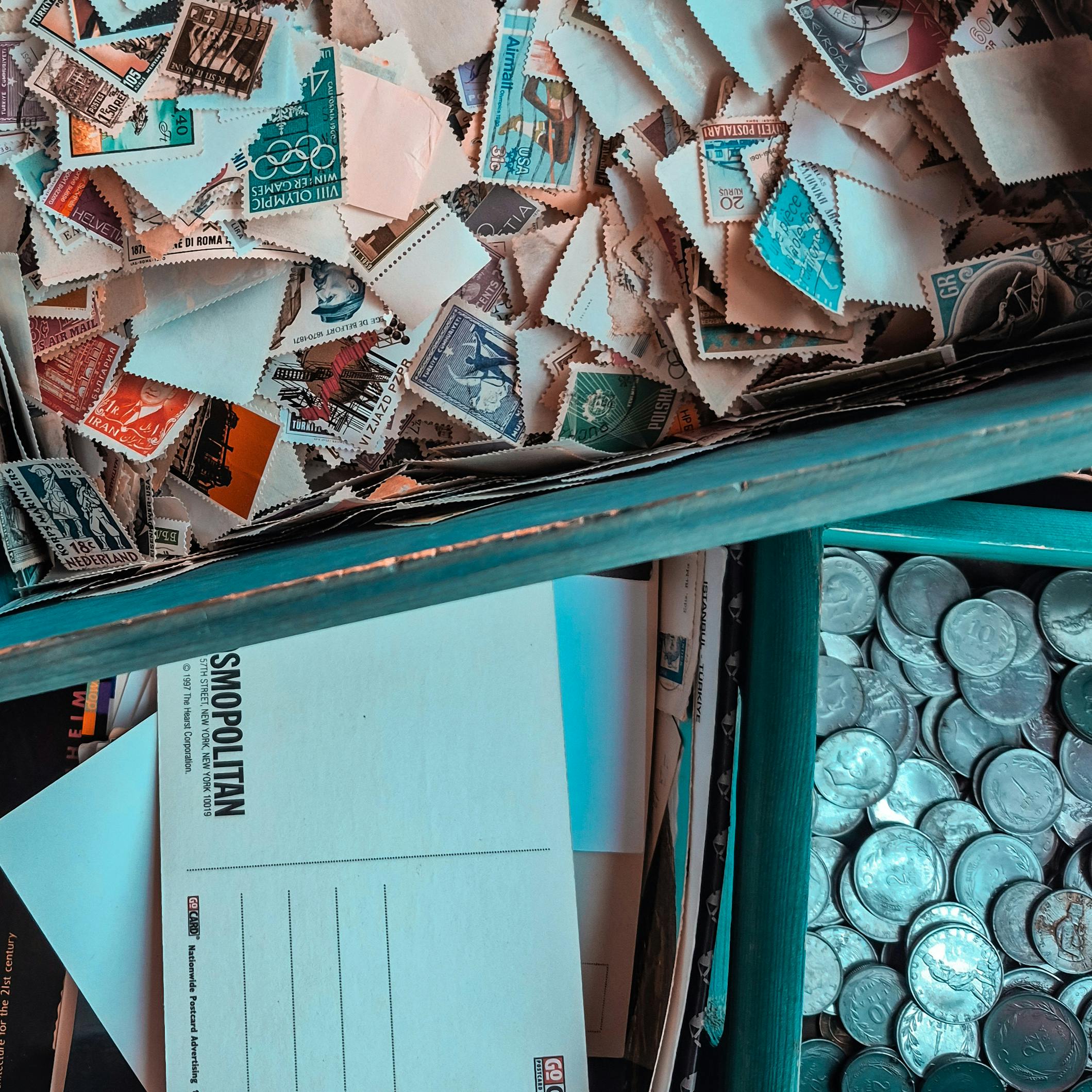
    The same applies to fossils, stamps, coins, model trains, vintage computers, or whatever flavour of obsession has currently attached itself to the brain.

    What often fascinates us isn’t simply the object itself but the system surrounding it.

    The classifications.

    The subtle differences.

    The exceptions to the rules.

    The one obscure variation that only three people on Earth appear to care about.

    Most people look at a shelf and see “a collection”.

    A pattern-seeking brain looks at the same shelf and sees a map.

    Every object has a place. Every category has a purpose. Every missing item creates a tiny itch in the back of the mind that quietly whispers:

    “You know exactly what’s supposed to go there.”

    The collection becomes more than a pile of things. It becomes a system to explore, understand and occasionally obsess over.

    And for brains that derive genuine pleasure from finding order amidst chaos, that’s immensely satisfying.

    Of course, collections aren’t just about categorisation and pattern-seeking. If they were, a spreadsheet would be every collector’s dream and nobody has ever become emotionally attached to a spreadsheet.

    Well… almost nobody. :embarrassed smiley:

    Over time, collections become something more than the objects themselves.

    A favourite book isn’t merely paper, ink and glue. A battered old slide rule isn’t simply a calculating device. A particular Rubik’s Cube isn’t just coloured plastic.

    They become markers in the timeline of our lives.

    Some remind us of places we’ve been.

    Others remind us of people we’ve known.

    Some represent achievements, discoveries or periods when life felt particularly good.

    Others survived difficult times and somehow became associated with comfort, familiarity and stability.

    For many neurodivergent people, objects can provide a reassuring sense of permanence in a world that often feels unpredictable.

    People change.

    Jobs change.

    Circumstances change.

    Favourite television programmes get cancelled.

    Entire social media platforms appear, dominate the internet for five years and then vanish into obscurity.

    But that slightly battered book you’ve owned for twenty years?

    It’s still there.

    That curious fossil sitting on the shelf?

    Still there.

    The collection remains a small constant in an ever-changing world.

    Objects also possess several advantages over people.

    They don’t judge your interests.

    They don’t suddenly decide they no longer like you.

    They don’t require careful interpretation of facial expressions, body language or implied meanings hidden beneath three layers of social convention.

    Most importantly, they don’t initiate small talk.

    I’ve yet to encounter a slide rule that felt compelled to discuss the weather.

    A collection is predictable. It has structure. It behaves according to understandable rules. You know where things belong and what purpose they serve.

    In a world that can sometimes feel noisy, confusing and chaotic, there is something deeply comforting about that.

    Perhaps that’s why collections often become emotional anchors.

    They’re not merely accumulations of objects.

    They’re accumulations of memories, interests, experiences and fragments of identity.

    They’re little pieces of ourselves arranged neatly on shelves.

    The Dopamine Hunt

    Then there’s the dopamine hunt.

    If autism often provides the catalogue, ADHD frequently supplies the expedition.

    For many collectors, the real excitement isn’t owning the item.

    It’s finding it.

    The search itself becomes the hobby.

    Tracking down a rare edition.

    Discovering an obscure variant.

    Learning some wonderfully unnecessary fact about a manufacturing change made in 1973.

    Completing a set that has been taunting you for years.

    It’s part treasure hunt, part side gather quest and part Pokémon for adults with back pain.

    An ADHD brain can derive astonishing amounts of happiness from locating a very specific obscure object that nobody else on Earth appears to care about.

    Hours of searching, weeks of waiting and countless dead ends can all evaporate the moment the target is finally acquired.

    Of course, this creates a slight problem.

    The dopamine was never entirely in the object.

    It was in the chase.

    Which explains why collectors are often found muttering the dangerous phrase:

    “I’m only looking…”

    Right before accidentally acquiring three more items for the collection.

    Some Collections Are Apparently More Respectable Than Others

    One of the more fascinating quirks of society is that some collections are considered sophisticated while others are considered evidence that you should perhaps be supervised more closely.

    Collect vintage wines and you’re a connoisseur.

    Collect rare watches and you’re an investor.

    Assemble a garage full of classic cars and people nod approvingly while using words like heritage and craftsmanship.

    Collect Rubik’s Cubes, slide rules or obscure retro clothing and suddenly you’re “that bloke with all the cubes” or “that fat prat in the cravat”.

    The strange thing is that the underlying behaviour is often identical.

    In both cases someone is spending considerable amounts of money acquiring objects they don’t strictly need, learning unnecessary amounts of information about them and becoming disproportionately excited when they discover a rare variant.

    Apparently spending £10,000 on a watch is a sensible investment.

    Spending £10 on a forty-year-old slide rule is a cry for help.

    I remain unconvinced by this distinction.

    The Danger Zone

    Of course, like most things that bring us comfort and enjoyment, collecting can occasionally wander into less healthy territory.

    A collection can become clutter if it grows faster than our ability to manage it.

    The thrill of acquisition can become an expensive habit.

    The search for the next item can sometimes become more important than appreciating the things we already have.

    For some people, collections can also become a form of avoidance; a way of retreating into a familiar and controllable world when life outside feels difficult, uncertain or overwhelming.

    There’s nothing inherently wrong with any of this.

    Most hobbies have their excesses.

    The trick, as with so many things, is balance.

    A collection should enrich your life, not consume it.

    It should be a source of joy, curiosity and comfort rather than stress, debt or obligation.

    After all, if your collection starts requiring its own collection to keep track of it, it may be time for a quiet sit-down and a cup of tea.

    Physical Objects in a Digital Age

    In an increasingly digital world, I sometimes wonder whether part of the appeal of collections is simply that they are real.

    So much of modern life exists behind glass screens.

    Books become files.

    Music becomes subscriptions.

    Photographs become pixels.

    Entire friendships can be reduced to a collection of messages stored on somebody else’s server.

    There’s nothing inherently wrong with any of that. The digital world has given us remarkable things.

    But digital experiences can sometimes feel strangely weightless.

    A physical object occupies space in the world.

    A book has weight in your hands.

    A fossil connects you to a creature that lived millions of years before the first human wondered where they left their keys.

    A slide rule carries the fingerprints of the engineers, scientists and students who once used it to understand the universe.

    These things have history.

    They’ve travelled through time.

    They existed before you discovered them and, with a little care, they’ll probably continue to exist long after you’re gone.

    Perhaps that’s part of what makes them meaningful.

    When I hold an old slide rule, I’m not simply looking at an obsolete calculating device.

    I’m holding a small piece of human ingenuity.

    A reminder that generations of curious people spent their lives trying to understand the world around them.

    In that sense, collections aren’t really about ownership.

    They’re about stewardship.

    For a little while, these objects become part of our story.

    Then one day they’ll become part of someone else’s.

    There’s something rather comforting about that.

    In Closing

    So yes, perhaps neurodivergent people do collect unusual things.

    But maybe that is because we notice unusual beauty.

    Maybe we find joy in patterns other people overlook, or comfort in systems that make sense to us, or delight in a slightly odd shelf of interesting nonsense that happens to look brilliant in our own particular internal lighting.

    Or maybe we just like collecting things that make us happy and occasionally confuse visitors.

    Honestly, it is probably all of the above.

    And really, that seems like a perfectly reasonable way to spend a life.

  • Growing Old without Growing Up.

    Growing Old without Growing Up.

    Growing older is inevitable. We can’t escape time’s relentless arrow.

    Becoming dull, joyless and terminally serious, however, is entirely optional.

    Somewhere along the journey into adulthood society quietly slips us a secret rulebook explaining which activities are considered acceptable and which are not. Which hobbies are “appropriate” and which enthusiasms should probably be packed away in the loft next to your old Action Men and abandoned dreams.

    Apparently the rules are something like this:

    • Assembling obscure collections = eccentric
    • Getting excited about games or toys = immature
    • Watching cartoons as an adult = deeply concerning
    • Discussing Discworld or Hitchhiker’s Guide lore at length = suspicious

    I appear to have misplaced my copy of the rulebook.

    But really… what is an adult?

    As children we assume adults understand life. We imagine they possess confidence, competence and secret knowledge unavailable to younger minds. Adults seem unfazed by everything. They understand taxes voluntarily. They know how insurance works. They probably even enjoy shopping for furniture in IKEA.

    You assume that one day a hidden switch in your brain will flip from Child Mode to Fully Operational Adult™ and suddenly the mysteries of existence will reveal themselves.

    Except that day never comes.

    Instead there’s just a gradual realisation that you’re no longer young. One day you’re racing down hills on a bicycle pretending to be a fighter pilot and the next you’re comparing broadband tariffs and wondering why your knee sounds like a creaky floorboard.

    Internally though?

    You still feel remarkably similar.

    You still have the same interests, fears, fascinations, anxieties and bizarre little enthusiasms. There’s a strange disconnect between your physical age and your internal self-image. In your head you’re still basically you, just with slightly more back pain and stronger opinions about kitchen appliances.

    Perhaps more worryingly, you eventually realise you’re now expected to be the responsible adult.

    You may even have children of your own who look up at you with the same wide-eyed certainty you once directed at your parents. They assume you know what you’re doing.

    Meanwhile internally you’re thinking:

    “I’m improvising wildly and hoping nobody notices here Kid!.”

    I still occasionally feel like three children in a trench coat trying very hard to pretend they understand mortgages.

    Although we don’t change much internally, society expects us to change externally. We’re expected to become relentlessly sensible. Calm. Productive. Emotionally stable. Proper grown-ups.

    Enthusiasm becomes embarrassing.

    Silliness becomes socially risky.

    Wonder becomes suspicious.

    Stoic calm and maturity becomes the norm.

    Personally, I think locking away curiosity, humour and joy in the name of adulthood does nobody any favours.

    Let’s talk about collections for a moment.

    You’re at a dinner party and someone asks what you do for fun.

    You explain that you collect slide rules, Rubik’s Cubes, fossils, cravats and old books.

    At this point you can actually watch them mentally powering down.

    You see the unspoken question slowly forming behind their eyes:

    “…why?”

    What they often don’t see is the curiosity behind it. The tactile pleasure. The fascination. The sense of continuity. The joy of holding strange little fragments of human creativity and history in your hands.

    To them it’s clutter.

    To you it’s wonder.

    Some people collect watches, paintings, cars or increasingly expensive kitchen gadgets. Depending on your social circle they may even collect spouses.

    But somewhere along the line adulthood collectively decided that joy should justify itself economically.

    I respectfully disagree.

    In Charlie and the Chocolate Factory, Mike Teevee complains that everything in the titular factory is pointless.

    Charlie replies:

    “Candy doesn’t have to have a point. That’s why it’s candy.”

    Exactly.

    Joy should exist for joy’s sake.

    Not everything meaningful has to be monetised, optimised or transformed into a side hustle for LinkedIn.

    As children our worries were relatively small. Did we have enough pocket money for sweets? Did we finish our homework? Would our Tamagotchi survive the weekend?

    Adulthood brings heavier concerns.

    Work. Money. Relationships. Responsibilities. Health. Anxiety. Stress.

    Your body also starts developing what can only be described as “design quirks”.

    Your eyesight deteriorates. Your waistline expands despite eating approximately the same foods you survived on perfectly well at twenty. Your hair either turns grey, disappears entirely or relocates mysteriously to your ears.

    And through all of this you’re still expected to project the calm, controlled demeanour of Proper Adulthood.

    But humour and joy are forms of resilience.

    They’re coping mechanisms that provide perspective on what actually matters.

    That isn’t avoidance.

    Sometimes humour is how humans carry heavy things without collapsing under the weight.

    There is, however, an important distinction between being childish and being childlike.

    Childishness is selfishness, irresponsibility and emotional immaturity.

    Childlikeness is curiosity, imagination, enthusiasm, creativity, playfulness and wonder.

    Unfortunately society confuses the two constantly.

    Push back against this whenever possible.

    There is absolutely nothing wrong with remaining curious about the world.

    At fifty-six years of age I’ve realised a few things:

    • Impressing everyone is impossible.
    • Fitting in is seriously overrated.
    • Most social rules were invented by people no wiser than you.
    • Life is finite and you only get one go at it.

    Once you realise this, something rather liberating happens.

    You give yourself permission to enjoy things openly.

    To dress oddly if it makes you happy.

    To collect weird objects, even if they are Spores, Moulds and Fungus. (Thanks Egon.)

    To laugh more.

    To stop pretending.

    To become more authentically yourself.

    So yes, I’m getting older.

    My knees occasionally produce noises worthy of a haunted mansion and I now make involuntary sound effects whenever standing up from a chair.

    But I still love puzzles.

    I still laugh at terrible jokes.

    I still make even worse puns.

    I still derive immense joy from simple things.

    I can still freewheel down a hill on a bicycle grinning like an idiot.

    And I may occasionally become unreasonably excited upon discovering an old bookshop or toyshop.

    Does that mean I never fully grew up?

    I can probably live with that.

    Quite happily, in fact.