Author: Pete Little

  • The Universe Doesn’t Give a **** About You!

    The Universe Doesn’t Give a **** About You!

    I’m sorry to be the one to break this to you, but the universe really doesn’t care a **** about you.

    It doesn’t care about your job, your bank balance, or the fact that Steve from Accounts got promoted ahead of you. It remains magnificently indifferent to all such concerns and, indeed, to most concerns in general. Entire stars explode with alarming regularity while I’m trying to remember where I left my reading glasses. The universe appears to regard these events as being of broadly equal insignificance.

    Oddly enough, I find that rather comforting.

    Many of us grow up with the idea that we’re here for a reason. Somewhere, hidden amongst the cosmic paperwork, there is supposedly a grand purpose waiting to be discovered. A destiny. A calling. Perhaps an ancient prophecy involving dramatic music, a glowing sword, and an unnecessarily complicated family tree.

    As far as I can tell, this is nonsense.

    You are not the chosen one.

    Neither am I.

    No great celestial bureaucrat sits above the clouds assigning each of us a special mission, a five-year plan, and an accompanying orchestral soundtrack. The universe has outsourced all personnel decisions and no longer answers correspondence.

    The good news is that if there is no grand cosmic plan for your life, then you cannot possibly fail to achieve it.

    You don’t have to become a billionaire (it’s trillionaires now – Ed) , a celebrity, a genius, or a historical footnote in order to justify your existence. You don’t need to leave a legacy, build an empire, or optimise your personal brand. Existing is not a performance review. There is no cosmic HR department quietly assessing your quarterly progress against strategic objectives.

    You are here.

    That is already enough. You already have worth and value.

    Of course, this brings us neatly to money.

    Now don’t get me wrong. Money is useful. Food, shelter, heating, books, bicycles, and the occasional cup of coffee all require money. The universe may be indifferent, but the electricity company certainly isn’t.

    Beyond a certain point, however, our relationship with money starts becoming a little strange. Financial security is sensible. Accumulating enough wealth to buy a small island, three yachts, and a solid-gold toilet while still worrying that you don’t have enough begins to resemble a dragon sleeping on a pile of treasure. Alas even some people on the planet at the moment would give Smaug a run for his money!

    At some point “more” stops meaning “enough” and starts meaning “because the spreadsheet said so”.

    That seems a very poor use of our limited time.

    Because time, not money, is the thing we’re actually running out of and no matter how much money you have… you cannot buy yourself more time.

    Here’s the great paradox.

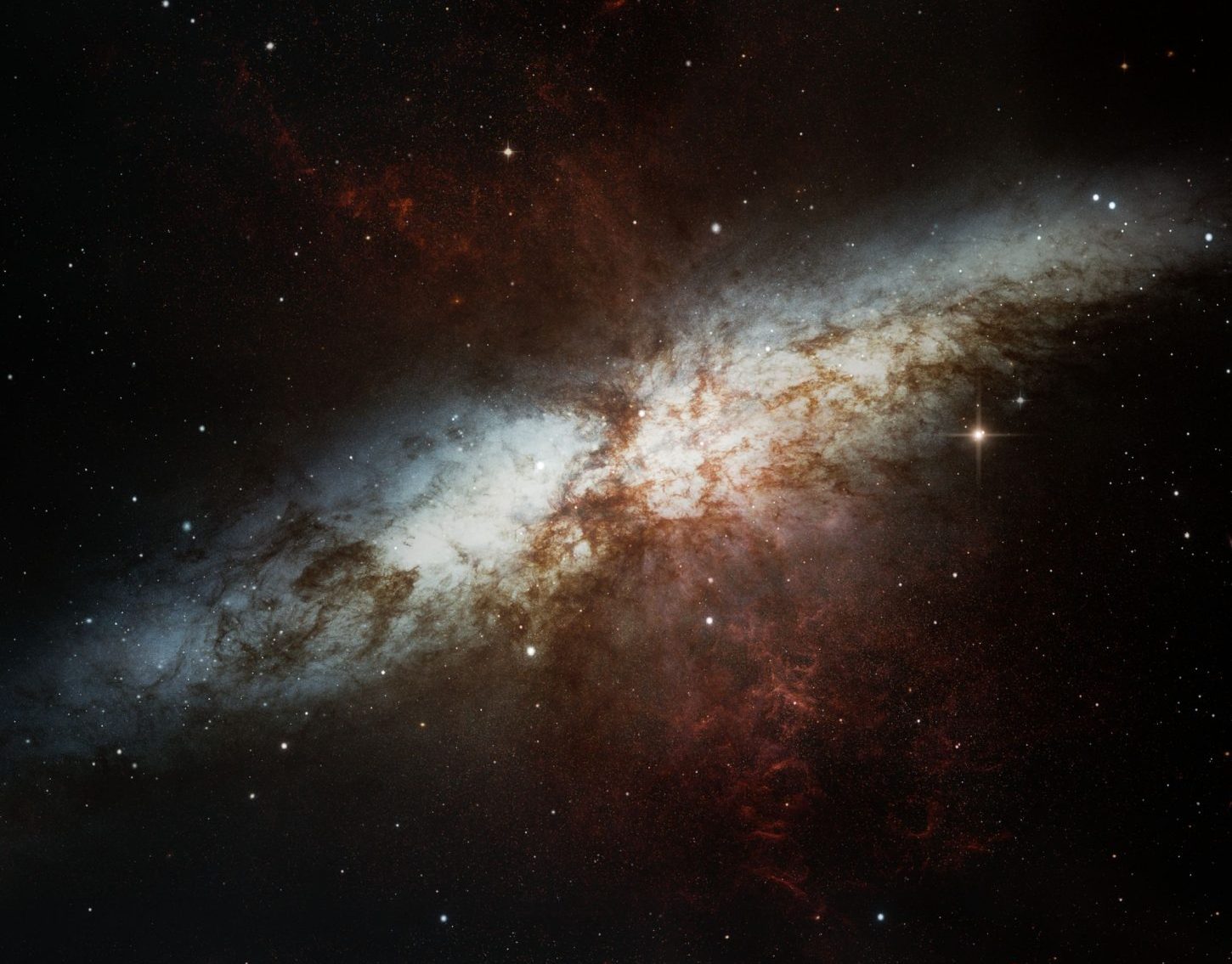
    Cosmically speaking, we are insignificant. Ridiculously so. The observable universe contains hundreds of billions of galaxies, each containing hundreds of billions of stars. Against that backdrop, the entire history of human civilisation barely registers as a rounding error.

    And yet there has never been another person exactly like you.

    There never will be again.

    The particular combination of memories, experiences, fears, hopes, talents, flaws, interests, favourite songs, terrible decisions, and peculiar habits that constitutes “you” has never existed before in the history of the universe. Every human being is both utterly insignificant and completely unique.

    The universe may not care.

    That doesn’t make you unimportant.

    It simply means your importance exists at a different scale.

    People spend an extraordinary amount of effort dividing themselves into tribes. Wealth. Religion. Nationality. Politics. Class. Social status. Favourite operating systems. Human beings seem unable to resist inventing categories and then arguing about them.

    Underneath all of that, however, we’re remarkably similar.

    We’re all temporary.

    We’re all fragile.

    We’re all making it up as we go along.

    We’re all trying to get through the week with some combination of dignity, optimism, caffeine, and luck.

    The labels we use to separate ourselves are often far less interesting than the things we share.

    Eventually every one of us will be gone.

    The kings.

    The billionaires. (Ahem trillionaires I said! – Ed)

    The influencers.

    The politicians.

    The people who spend all day arguing with strangers on the internet and who make “spreading hatred and misery” their mission.

    Especially them.

    One day the universe will forget every empire, every nation, every corporation, every social media platform, and every argument ever conducted online. Given enough time, all the works of mankind will vanish without trace. Even this great magnus opus you’re reading now will vanish (not a bad thing if you ask me – Ed)

    And honestly?

    That’s fine.

    I don’t find that depressing.

    I find it liberating.

    If our time here is brief and the universe has no grand plan for us, then we’re free to decide for ourselves what matters. We can learn interesting things. We can read good books. We can listen to great music. We can collect ridiculous objects. We can fall in love. We can build friendships. We can help one another where we can and, as a general rule, try not to make somebody else’s brief existence more difficult than it needs to be.

    We are all mayflies on a small rock hurtling through an indifferent cosmos.

    We may as well make the experience pleasant.

    So make the tea.

    Take the walk.

    Read the book.

    Listen to the music.

    Buy the absurd thing if it genuinely delights you and doesn’t bankrupt you.

    Laugh often.

    Be kind.

    Learn things.

    Share things.

    Help people.

    The universe doesn’t give a **** about you.

    Which is precisely why we should give a damn about each other.

  • Smell Is Basically a Superpower

    Smell Is Basically a Superpower

    People often ask me what it’s like not being able to smell.

    The honest answer is:

    I haven’t the faintest idea.

    If that sounds odd, then consider this: I’ve never experienced life with a sense of smell, so how can I possibly say what life is like without it?

    To me, smell occupies roughly the same category as telepathy, X-ray vision, and flying.

    I understand the theory.

    I simply have no frame of reference for the experience.

    What Exactly Is Congenital Anosmia?

    Put simply, anosmia is the lack of a sense of smell.

    Anosmia is to smell what blindness is to sight, or deafness is to hearing.

    Congenital means I was born this way.

    I didn’t lose my sense of smell later in life.

    I never had it in the first place.

    Technically, anosmia is the complete absence of smell. There is actually a spectrum of smell-related conditions, of which anosmia is just one.

    Anosmia

    The complete absence of any sense of smell.

    Hyposmia

    A reduced sense of smell. Think of it as turning the detection volume down.

    Phantosmia

    Smelling things that aren’t there.

    I hear this one can be pretty awful for sufferers.

    My brain obviously never generates imaginary smells. It has enough trouble detecting real ones.

    Parosmia

    Distorted smells.

    Coffee may smell like burning rubber. Perfume may smell acrid or unpleasant.

    Unfortunately, following COVID, cases of parosmia, hyposmia, and anosmia all became significantly more common.

    So now you know what the various smell disorders are.

    How is congenital anosmia different?

    You Can’t Miss What You Never Had

    Well, I’ve never had a sense of smell.

    Never experienced what smell is.

    To me, the sense of smell is effectively a fictional experience.

    Someone who acquires anosmia later in life, through illness, infection, head trauma, tumours, or simply old age, experiences a genuine sense of loss.

    They remember smell.

    They miss smell.

    They know what coffee smelled like.

    Freshly baked bread.

    Cut grass.

    Rain.

    Those memories remain even after the sense itself has gone.

    In some ways, being born without a sense of smell is easier.

    That may sound strange, but it really doesn’t bother me.

    That’s not to say it isn’t serious.

    Depression among people who lose their sense of smell later in life is sadly quite common.

    I do not envy them their memories.

    People often ask whether I feel I’ve missed out.

    It’s a bit like asking how I cope with losing £100 billion on the stock market.

    I haven’t lost £100 billion on the stock market.

    I never had £100 billion on the stock market.

    I’m aware that both smell and £100 billion exist.

    My emotional relationship with either is somewhat limited by their complete absence from my life.

    Smell as a Superpower

    I’ll tell someone I’m anosmic and can’t smell, and invariably I get variations of the same conversation.

    “What? You can’t smell coffee?”

    “No.”

    “What about burnt toast?”

    “No.”

    “What about aftershave?”

    “No.”

    At this point the conversation starts descending into that famous scene from BBC’s Red Dwarf.

    “Everybody’s dead, Dave.”

    “What, Captain Hollister?”

    “Everybody’s dead, Dave.”

    “What, Peterson?”

    “Everybody’s dead, Dave.”

    No.

    I can’t smell coffee.

    I can’t smell toast.

    I can’t smell aftershave.

    I can’t smell anything.

    Funny as it is, it becomes a little tiring after the hundredth repetition.

    These days, when someone asks:

    “So you can’t smell roses?”

    I sometimes reply:

    “Can you see through walls?”

    Both questions are equally unhelpful to understanding.

    I then explain that I know smell exists and I know Superman can see through walls.

    I understand the theory.

    I simply don’t, and never will, understand the experience itself.

    I understand smell intellectually in much the same way I understand quantum mechanics.

    I accept that it exists.

    I can even comprehend some of the details of the process.

    Beyond that, things become rather fuzzy.

    Things People Forget Smell Does

    Once people understand that I can’t smell, I occasionally get this sort of response:

    “Ooh, lucky you. You’ll never have to experience a hot, sweaty Tube train.”

    I usually have rather less patience with this one.

    My response is generally something along the lines of:

    “And blind people never have to experience what passes for modern art these days.”

    Smell is an important sense.

    Not only is it heavily linked to flavour, but it also contributes significantly to memory and environmental awareness.

    Taste itself is largely handled by the tongue and remains unaffected. We can detect sweet, sour, salty, bitter and umami flavours, as well as sensations like the cooling effect of menthol and the burning sensation of capsaicin.

    Smell, however, contributes enormously to the richness and complexity of flavour.

    It’s also closely connected to memory.

    The olfactory bulb has direct connections to parts of the brain involved in emotion and memory, particularly the amygdala and hippocampus.

    There’s a reason certain smells can instantly transport people back to childhood and why senses are important in laying down new memories.

    My memories simply use different triggers.

    Smell also provides environmental awareness.

    It helps detect danger.

    It warns of fires, gas leaks, spoiled food and other hazards.

    I’ve had so many cases of food poisoning over my lifetime that I’ve genuinely lost count.

    So yes, there are disadvantages.

    Detecting spoiled food.

    Detecting smoke.

    Detecting gas leaks.

    These are all things I have to think about differently.

    That said, there are advantages too.

    I grew up on a dairy farm.

    Without going into too much detail, I’m sure you can imagine at least some of them.

    Summing Up

    Do I wish I could smell?

    Of course.

    Curiosity alone would make it worthwhile.

    I’d love to know what coffee smells like.

    Or petrichor after rain.

    Or my wife’s perfume.

    Or whether everybody has been telling the truth about bacon all these years.

    But congenital anosmia isn’t really a story about loss.

    You can’t lose something you never had.

    It’s simply a different way of experiencing the world.

    Besides, the only thing I know for certain that stinks is my sense of humour.

  • The Internet Was More Interesting Before Everything Became a Platform

    The Internet Was More Interesting Before Everything Became a Platform

    I remember the early days of the internet.

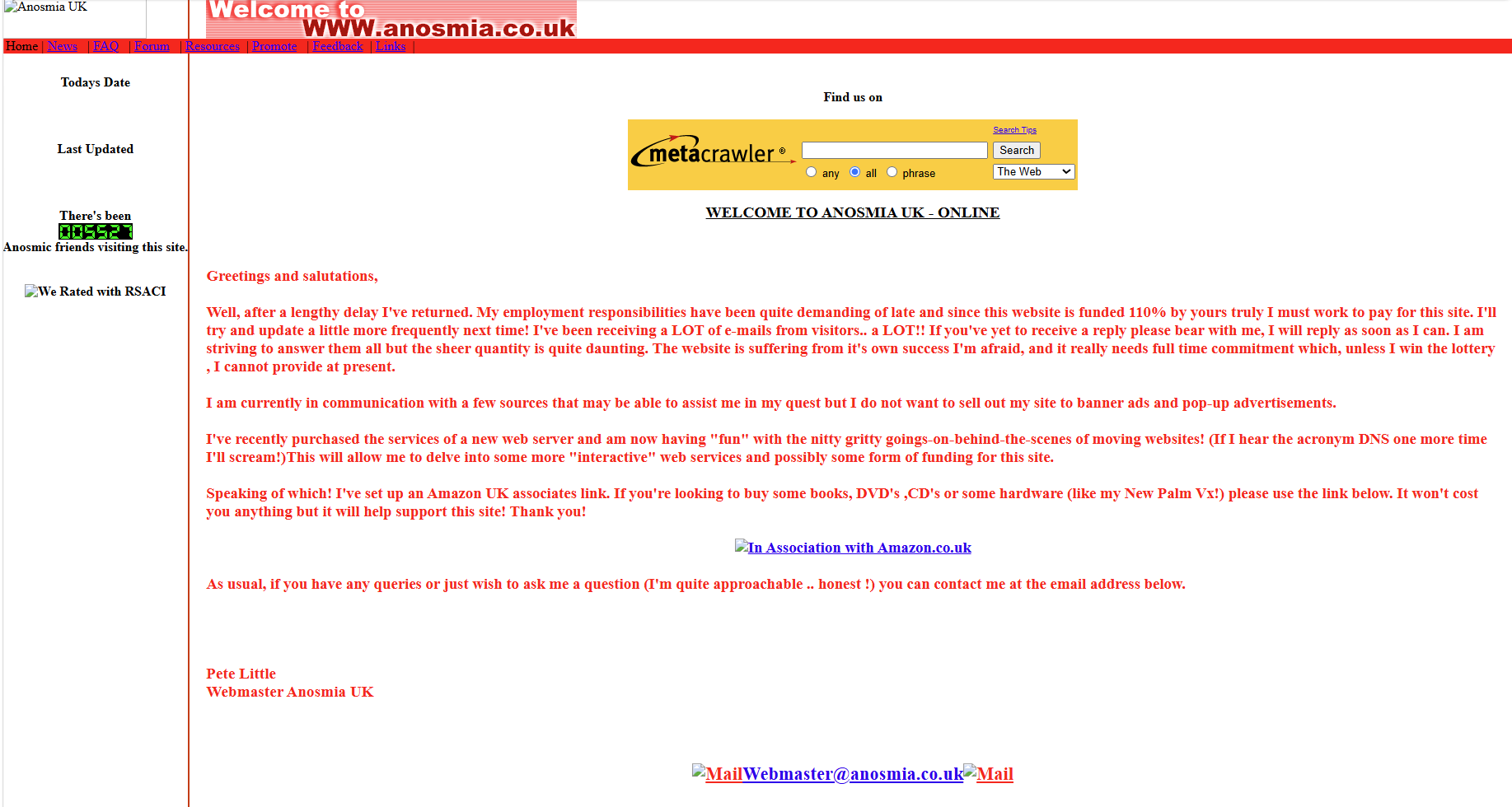
    I remember the terrible websites with flashing green text on red backgrounds, animated GIFs in abundance, JavaScript visitor counters at the bottom of the page, MIDI tunes that started playing when you accessed the site, and entire websites dedicated to someone’s hamster.

    (Guilty as charged, m’lud.)

    And you know what?

    It was GLORIOUS!

    Don’t worry, this isn’t an “old man yells at cloud infrastructure” post.

    The old internet wasn’t perfect, it wasn’t ideal, and it certainly wasn’t always safe.

    However, what it was, was quintessentially human.

    THE INTERNET USED TO FEEL GEOGRAPHICAL

    The actual internet was a highway.

    It wasn’t the destination, but the means of travelling between weird towns, villages, and hamlets, each of which specialised in… well… something.

    Much like the towns in the Mad Max universe, where you have Bartertown, Gastown, Bullet Farm, and Tomorrow-morrow Land, the internet had Hamsterville, Catopolis, Conspiracy Creek, and Anosmia Acres.

    I was a serial website owner.

    I ran an anosmia support forum which, somehow, got me on television for my fifteen minutes of fame.

    Its design may well have made visitors’ eyes bleed, granted, but as it was a support group for people with no sense of smell, it was perhaps appropriate that my design stank. (See featured image from The Internet archive above!)

    I ran a joke conspiracy PHPBB forum called the UK Conspiracy Nexus, where every “member” was another character I had created and all the posts, arguments, and discussions were written by me.

    I deliberately invented ridiculous conspiracy theories, such as the connection between Toblerone and Illuminati mind-control dentistry.

    It’s the triangular shape, you see.

    It was all good fun… until I noticed my posts being shared non-ironically on more “serious” conspiracy sites.

    Dear God.

    What did I spawn?

    I also created a maths and general nerdiness site dedicated to things geeks might find “sexy” (that is to say, cool).

    In hindsight, calling it Sex4Geeks was perhaps inviting exactly the sort of dubious attention it received.

    That site was short-lived.

    It did, however, end up becoming a joke in my best man’s wedding speech.

    Pete?

    Naive much?

    Heck yes.

    But the internet was full of things like this.

    BBSs.

    Usenet.

    Forums.

    IRC.

    Personal webpages written in hand-crafted HTML.

    It wasn’t one place.

    It was thousands of interconnected little places, each with their own personality, culture, and rules.

    You didn’t live there.

    You visited.

    You travelled between them.

    You discovered them.

    You got lost.

    Wonderfully so.

    NOBODY NEEDED A BUSINESS PLAN

    The majority of the internet back then existed for one reason.

    Someone cared about something enough to make something about it.

    Not because they wanted followers, subscribers, sponsorships, or monetisation.

    It was because somebody cared enough about model railways, their collection of Tamagotchis, or the history of the China tea trade.

    They had passion and they wanted to share it.

    There was a website for every niche interest and most of them looked as though they had been assembled during an environmental catastrophe and built entirely in the dark.

    THE GREAT CONSOLIDATION

    Of course, initially seen as a fad, the internet proved it wasn’t going anywhere.

    People realised its potential.

    You could now order a pizza online.

    Such a technological breakthrough is something we take entirely for granted nowadays.

    Companies with ideas and dollar signs in their eyes jumped in.

    Slowly, giants emerged from the chaos.

    Where once there had been millions of random amateur websites, suddenly you had Facebook, Twitter, and MySpace.

    Then YouTube, Reddit, Instagram, and TikTok.

    These places acted like magnets, drawing in the weird from the satellite towns, villages, and hamlets, and housing them instead in vast digital metropolises.

    THE ALGORITHMS THAT ATE DISCOVERY

    Finding things used to be an adventure.

    There were a few basic search engines, reciprocal links, blogrolls, and web rings connecting like-minded sites together.

    You would wander around them feeling as though you were forging your own path through a strange and fascinating landscape.

    You discovered what people made.

    You sought out things that interested you.

    Now we no longer discover what people made.

    We discover what the algorithms, working on behalf of the platforms, want us to see.

    Want your site to appear first in search results?

    Just pay lots of money.

    It’s even worse now with AI-generated summaries appearing above the sites that originally created the content.

    In the pursuit of making things easier, we lost something human along the way.

    THE DEATH OF WEIRD

    The old internet was eccentric, amateur, and personal.

    Websites now look polished, optimised, branded, and laden with “smart” features.

    The old internet may have looked like a terrible hodgepodge mess, but it looked like somebody.

    It was human.

    Much of today’s internet looks like a corporation.

    A polished, focus-grouped, metrics-driven corporation.

    A CONFESSION

    Nostalgia is a terrible historian.

    As Baz Luhrmann famously said:

    “Nostalgia is a way of fishing the past from the disposal, wiping it off, painting over the ugly parts, and recycling it for more than it’s worth.”

    The old internet had its fair share of problems.

    Awful design.

    Scams.

    Misinformation.

    Toxicity.

    Every village conspiracy nut could find a like-minded community and build little echo chambers where the worst ideas fed off one another and grew.

    I’m not arguing that the old internet was perfect.

    I’m simply saying it was more human.

    We still have scams, misinformation, and toxicity.

    Now it’s just run by a handful of billionaire puppet masters.

    WE LOST MORE THAN WEBSITES

    The real loss wasn’t the technology.

    That grew.

    Who would have imagined we’d one day carry around access to the sum total of human knowledge on a small device that fits in the palm of our hand?

    We lost individuality.

    Experimentation.

    Curiosity.

    And yes, weirdness.

    The internet became a consumer space for selling content rather than a creative space for sharing ideas.

    IN CONCLUSION

    Perhaps that’s one of the reasons I reincarnated this blog.

    Not because I expect thousands of readers.

    Not because I have a monetisation strategy.

    Not because some marketing consultant told me to build my personal brand.

    No.

    Because I miss people having little corners of the internet that belonged to them.

    Places where we could be knowledgeable, enthusiastic, eccentric, or even completely wrong about something.

    Places that felt human.

    The internet may have become a platform, but there’s still room for the occasional strange little website.

    Or should I say, in my case, the occasional strange Little website.

    This is my own weird nest on the web.

  • The Difference Between Sound and Noise.

    The Difference Between Sound and Noise.

    I’m a bit of a contradiction when it comes to my autistic sensibilities.

    I cannot tolerate noise.

    Office chatter, traffic noise, dripping taps, ticking clocks, snoring, eating sounds (misophonia), or other people’s phone calls and conversations in general.

    This would lead you to think I am sensory avoidant and, to some extent, I am.

    However, My autistic noise sensitivity has an exception, I adore music.

    Music is one of my great pleasures in life.

    My noise-cancelling headphones are rarely off my head. I wear them as soon as I leave the house or office and listen to music constantly.

    My musical tastes can best be described as:

    “Yes.”

    On any given day I might listen to progressive rock, punk, heavy metal, opera, film soundtracks, musical theatre, dad rock, classical music, or, on particularly unusual afternoons, Mongolian throat singing.

    Spotify’s recommendation algorithm has long since given up trying to profile me and now simply appears to be selecting tracks using a random number generator and mild panic.

    In the world of sound there is a profound difference between music and noise.

    Music is controlled, predictable, and chosen.

    Noise is intrusive, random, unwarranted and, in most cases, unavoidable.

    I live in London.

    It’s hardly a haven of peace, calm and quiet serenity and not a place for someone with autistic noise sensitivity!

    Well, bits of it can be. More on that later.

    But the city isn’t designed to be noisy. It’s not even designed to be quiet. Noise is simply an unavoidable side effect of being a large, bustling metropolis.

    London is a loud place.

    Then again, it’s not always about volume.

    It’s about the inescapable wall of sound and its chaotic, unpredictable nature.

    Noise Fatigue

    Being constantly immersed in a sea of sound is draining.

    Much like Chinese water torture, it slowly chips away at my calm and increases my cognitive overload. External noise increases my internal static and makes my stammer worse.

    This results in difficulty concentrating, feeling worn out, exhaustion and an increased likelihood of meltdown.

    Death by a thousand auditory paper cuts.

    The Survival Equipment

    In order to get through the day with minimal fuss, I have an everyday carry survival kit.

    • My noise-cancelling headphones (a battered pair of Sony WH-1000XM3s held together with duct tape)
    • Loop Quiet earplugs
    • A spare set of fallback Bluetooth earbuds (some cheap brand, as I keep losing them)

    My morning routine as I leave the house is:

    Headphones.

    Keys.

    Wallet.

    Usually in that order.

    I’d rather discover I’d forgotten my wallet or my keys than my headphones, which probably says something quite worrying about me.

    More worrying, perhaps, is that I’ve frequently forgotten the latter, but as long as I have my headphones I’m fine.

    I may not be able to get back into the house.

    I may not be able to buy lunch.

    But hey, at least I’m not exposed to noise.

    Havens of Calm in the Chaos

    As mentioned above, not all of London is a hellish soundscape.

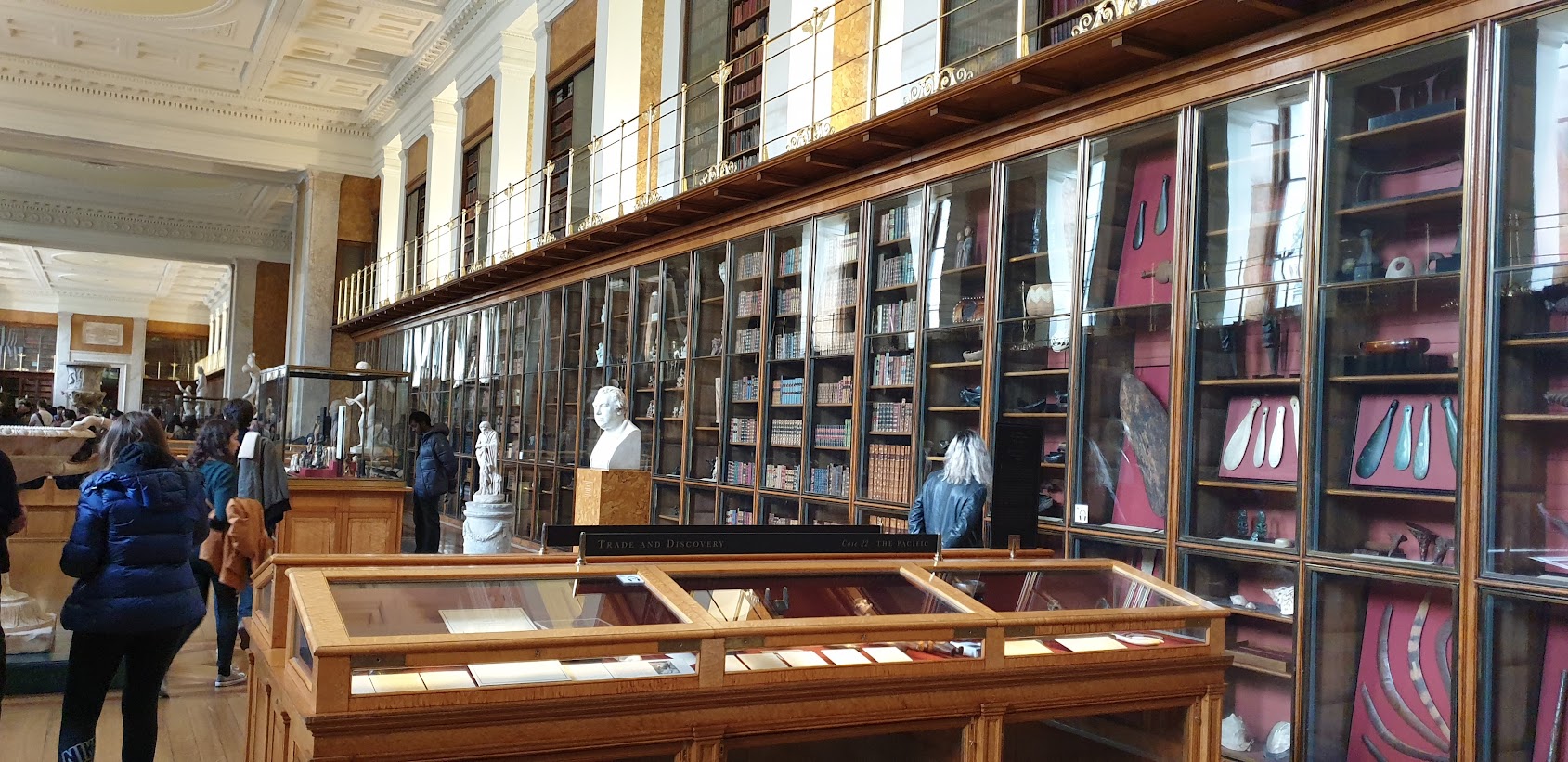
    For all its flaws, London has an astounding number of parks, museums, churches and galleries.

    When I’m in the middle of London I can often find much-needed respite by nipping into one of the many parks and listening to birdsong, or by popping into a museum or gallery to calm my inner turmoil.

    And although I’m not a religious person, I do love the peaceful calm of a church or cathedral.

    I can understand why those of a more spiritual nature feel something in such places.

    The peace is almost palpable.

    Like a comforting presence.

    Closing Thoughts

    So yes, I love sound.

    At least, I love music and the sounds of nature.

    I love birdsong, babbling brooks, complex harmonies, soaring orchestras, distorted guitars, operatic voices and whatever noise Mongolian throat singers have somehow persuaded their anatomy to produce.

    What I don’t love is my brain trying to process every single noise in the environment simultaneously.

    The difference between music and noise isn’t volume.

    It’s consent.

    One I invited in.

    The other kicked the door down and started defecating on the furniture.

  • Pride Month and the Anxious Asexual

    Pride Month and the Anxious Asexual

    This is a post I thought I might not write.

    Not because I’m ashamed or anything, but mainly because I wasn’t sure I could do it justice.

    It’s LGBTQIA+ Month (June), coinciding with and commemorating the Stonewall riots. It’s a month of marches, festivals and parades celebrating the LGBTQIA+ community, promoting equality and acceptance, and remembering the activism that laid the bedrock for many of the rights we enjoy today.

    Every June, my social media fills with rainbow flags, Pride events, celebrations and discussions.

    And every June I find myself wondering the same thing:

    Am I allowed to be here?

    The Invisible Letter

    I’ve always carried a nagging feeling that perhaps I shouldn’t.

    Maybe if I expand the acronym from LGBTQ+ to LGBTQIA+, I feel a little more comfortable including myself. It’s that all-important A at the end.

    A for Asexual, Aromantic or Agender.

    I am, for my sins, asexual.

    One of the main reasons I struggle to include myself in LGBTQIA+ festivities is what is often called passing privilege.

    Nothing about me, save perhaps my asexual flag pin or rainbow lanyard, immediately singles me out as “different”.

    My autism is invisible.

    My congenital anosmia is invisible.

    My asexuality is equally invisible.

    I’ve never been picked on, abused, beaten up or discriminated against for things people couldn’t see.

    Most people assume I am straight, and unless I choose to disclose my asexuality, I can move through the world without attracting much attention.

    That can create a feeling of awkwardness, or even guilt, when engaging with LGBTQIA+ spaces.

    I feel as though others have fought battles that I have largely been spared.

    Yet invisibility brings its own challenges.

    Asexuality is frequently misunderstood, dismissed or erased entirely.

    The result is a curious sense of standing both inside and outside the community at the same time; connected to its struggles and history, while sometimes feeling hesitant to claim a place within it.

    The Feeling of Not Being “Queer Enough”

    I often wonder whether I should even be here.

    Am I taking up space meant for others?

    Do I really belong?

    Am I part of the community or merely an ally?

    Should I even describe myself as LGBTQIA+?

    These questions are surprisingly common among asexual people.

    I and those like me spend so much time being overlooked that we can end up overlooking ourselves.

    Pride Isn’t Actually About Sex

    One of the reasons asexuality can seem confusing to people outside the community is that many assume LGBTQIA+ identities are fundamentally about sex.

    Mention Pride and some people’s minds immediately jump to attraction, relationships and sexuality.

    Viewed through that lens, asexuality appears to be an odd fit.

    After all, how can someone who experiences little or no sexual attraction belong within a community that many outsiders mistakenly define by sexual attraction?

    The answer is simple.

    Pride has never really been about sex.

    At its heart, Pride is about identity.

    It’s about authenticity.

    It’s about visibility and community.

    It’s about recognising that human beings don’t all fit neatly into society’s expectations and that nobody should be shamed for existing outside those expectations.

    Asexual people understand that experience all too well.

    Many of us grew up feeling different without quite understanding why.

    We watched friends develop crushes, navigate relationships and talk about attraction in ways that simply didn’t resonate with our own experiences.

    Some of us spent years wondering whether we were late bloomers, broken, repressed or somehow missing a piece of ourselves.

    The journey may look different from those of other LGBTQIA+ people, but the underlying themes of self-discovery, acceptance and belonging are often remarkably familiar.

    The Ace Spectrum

    It’s also worth remembering that asexuality isn’t a single, uniform experience.

    The ace umbrella encompasses a wide spectrum of identities, including demisexual and grey-asexual people whose experiences of attraction may be infrequent, conditional or significantly different from what society considers typical.

    In my own case, I’ve been very happily married for seventeen years, which often surprises people when they learn that I’m ace.

    One of the most persistent misconceptions about asexuality is that it somehow excludes relationships, intimacy or deep emotional connections.

    It doesn’t.

    Being ace isn’t necessarily about the absence of love, companionship or commitment; it’s about the way attraction is experienced.

    The ace spectrum is broad enough to include people who never experience sexual attraction, those who experience it only rarely, and those for whom it emerges primarily from strong emotional bonds.

    Human relationships, as it turns out, are rather more nuanced than simple tick-box categories.

    Why Pride Matters

    Pride celebrates the freedom to exist honestly.

    It celebrates the right to be seen as who you are rather than who society expects you to be.

    Those are things asexual people share completely with the wider LGBTQIA+ community.

    You don’t need to experience sexual attraction to understand the importance of authenticity.

    And you certainly don’t need to experience sexual attraction to deserve a place at Pride.

    In Closing

    Perhaps that’s what I’ve slowly come to realise over the years.

    Pride isn’t a competition.

    It’s not awarded based on visibility, hardship or how obvious your identity is to strangers.

    It’s not about proving you’re “queer enough”.

    It’s about recognising that people come in many different forms and that none of them should have to hide who they are.

    Including those of us whose differences are invisible.

    Including those of us who sometimes stand at the edge of the parade wondering whether we should even be there.

    We do.

    And maybe that’s reason enough to celebrate.

  • This Post Was Written by AI

    This Post Was Written by AI

    Wait, just wait…

    By “AI” I do, of course, mean an Actual Idiot.

    Namely, myself.

    Obvious clickbait title, eh? Thought that’d catch you!

    Let me elucidate.

    Actually, no. Let me explain.

    Words like elucidate are what got me into this mess in the first place.

    Despite my best intentions, I apparently sound artificial.

    I’m not offended by this. In fact, I’m quite fascinated by it.

    I’d noticed that my writing scored embarrassingly highly on various online “Was this written by AI?” tests. At first I couldn’t understand why.

    Well, that’s not entirely true.

    I had a fair-to-middling idea why.

    It’s my writing style.

    It’s too… measured.

    Too formal.

    Too structured.

    Too fond of words like fair-to-middling.

    I grew up with a fairly severe stammer. (See my previous post about that.)

    As a result, I spoke slowly and used small, simple words. But just because I spoke slowly, chose my words carefully and delivered them in a flat, measured manner didn’t mean I lacked a vocabulary.

    Far from it.

    I was a voracious reader.

    If there was something to read, I read it.

    Books.

    Magazines.

    Newspapers.

    Encyclopedias.

    Dictionaries.

    The backs of cereal boxes.

    If it contained words, it was fair game.

    My nose was almost permanently buried in a book.

    I developed a particular fondness for older literature. Poe, Lovecraft, Shelley, Dumas, Dickens and many others filled my head with strange vocabulary and elaborate sentence structures.

    Reading dictionaries and encyclopedias gave me a phenomenal vocabulary. Positively Brobdingnagian, one might say.

    (I use that word rather a lot. It’s one of my favourites. Perhaps I should stick with “Big” going forward?)

    My irritating near-photographic memory meant I accumulated a vast store of facts and trivia. So much so that my parents’ nickname for me was “The Professor”, because I was always explaining how something worked, who invented it or why some obscure historical event mattered.

    In public, however, I was deeply introverted.

    I embodied the old instruction:

    “Speak when you’re spoken to.”

    And even then, I generally replied with the minimum amount necessary to remain polite.

    I developed an inferiority complex that never entirely left me.

    I’m fifty-six years old.

    I work for a large multinational IT company and support some fairly significant clients.

    Think military.

    Think government.

    Think organisations with enough bureaucracy to make Kafka and Orwell ask everyone to calm down.

    And yet, in my head, I’m still just a code monkey.

    Most people my age have become team leaders, managers, senior managers or directors.

    Not me.

    I never particularly wanted promotion.

    I lack anything resembling a healthy ego.

    I’m just as happy writing a flagship application or major piece of software as I am testing somebody else’s code or filling out administrative paperwork.

    I’ve never been good at putting myself forward.

    I rarely assume excellence.

    I rarely even claim competence.

    Which is ridiculous, of course.

    I know I’m good at what I do.

    I find that difficult to say.

    In fact, if I’m being painfully honest, I’m very good at what I do.

    There. I’ve said it.

    Please don’t make me do it again.

    At university, the expected trajectory by my peers was a PhD.

    Instead I dropped out at the end of my BSc before my Masters.

    Why?

    Because I couldn’t picture myself as a doctor.

    (Albeit a Doctor of Mathematics rather than the Gallifreyan variety.)

    Me?

    A stammering working-class lad from a family of labourers and cooks?

    I knew my place.

    And in my mind, it certainly wasn’t “Doctor”.

    The imposter syndrome hit me big time.

    Looking back, that says rather more about me than it does about academia.

    My lack of ambition and reluctance to promote myself influences my writing too.

    I minimise myself.

    I soften statements.

    I hedge.

    I qualify.

    I write passively because active statements feel uncomfortably close to boasting.

    Even writing this article feels slightly unnatural.

    I’ve deliberately filled it with “I am”, “I did” and “I think” statements.

    Normally I’d be restructuring sentences, removing myself from them and quietly disappearing into the background.

    The urge to do so is considerable.

    I’m resisting it for the sake of the experiment.

    So perhaps that’s why AI detectors think I’m an AI.

    Not because I write like a machine.

    But because I write in a style that is structured, measured and oddly formal.

    The irony is that I was probably sounding like this long before anybody took artificial intelligence seriously.

    For the record, I’m not particularly an AI enthusiast.

    My mathematical background means I understand the statistical prediction and pattern-matching taking place beneath the surface.

    My IT background helps me understand the engineering behind it.

    I find the technology fascinating.

    I find many of its applications considerably less so.

    Personally, I wouldn’t trust a large language model to write a postcard, let alone a blog or novel.

    Speaking of novels, I have one.

    Actually, I have ten.

    Although, technically, they’re ten versions of the same novel.

    None of them will ever be published because none of them will ever be finished.

    I keep discovering ways to improve them.

    Or ruin them.

    The distinction becomes increasingly blurry after version seven.

    As for AI-generated writing?

    I find much of it technically impressive but emotionally hollow.

    Competent.

    Coherent.

    Soulless.

    Perhaps that’s why I’m amused when people accuse me of writing like an AI.

    I’ve spent a lifetime trying to figure out how to sound more human.

    It would be deeply ironic if I finally succeeded just as the machines started sounding like me.

    BEEP BOOP.. END OF POST ERROR : REFILL #C0FFEE.

  • Small Talk Is TCP Handshaking for Humans

    Small Talk Is TCP Handshaking for Humans

    I have long suspected that small talk is not really about talking at all. I mean, obviously it’s about talking, but it’s not about imparting information or saying anything of actual interest.

    It is, I think, more accurately described as a kind of human protocol negotiation. A lightweight exchange whose purpose is not to transfer meaningful information, but to confirm that both parties are present, functional, and broadly willing to proceed without causing a scene.

    In computer networking terms, it feels rather a lot like a TCP three-way handshake.

    That may sound like an over-complicated way to describe “Morning” and “Busy day?” but I maintain it is exactly the right amount of over-complication.

    The analogy works on several levels at once.

    TCP handshakeHuman small talk
    SYN“Morning.”
    SYN/ACK“Morning. Busy today?”
    ACK“Yeah, not too bad.”
    Connection establishedActual conversation may now proceed

    The actual content is almost irrelevant.

    The handshake exists to establish availability, willingness, compatibility, safety, and communication parameters. Small talk does much the same thing. It is not there to win prizes for insight. It is there to say, in the safest possible way:

    I see you. You seem non-threatening. We may now continue.

    That is quite a useful invention, really.

    It is also, for some of us, faintly bewildering.

    Because my brain has a tendency to assume conversations should do one of three things:

    1. exchange useful information.
    2. explore an interesting idea.
    3. contain at least one genuinely terrible joke.

    Small talk often does none of these things.

    Which is not to say it is pointless. Far from it. It is just that its point is not always the same as the point my brain is looking for.

    That can make it feel a bit like packet loss.

    Some of the signal gets through. Some of it doesn’t. A few words arrive intact, but the important meaning seems to have been dropped somewhere between the intention and the execution.

    The weather is discussed.

    The weekend is mentioned.

    A vague inquiry is made about one’s wellbeing.

    And yet the actual data being transmitted is something like:

    I am safe. You are safe. We may continue this interaction without immediate risk of social collapse.

    That is a rather elegant system when it works properly.

    It is also a system with some spectacular failure modes.

    Failed Handshake

    Sometimes the handshake fails immediately.

    You offer the smallest possible opening.

    “Morning.”

    And the other person replies:

    “Is it? I mean the way the world’s going it might as well be the end of days. The planet’s going to hell in a hand basket and we’re all doomed.”

    At that point the connection has not merely failed. It has been forcibly terminated, the cable has been unplugged, and the router has probably started smoking.

    Connection reset by peer.

    Timeout

    Then there is the timeout problem.

    Someone asks:

    “How are you?”

    and the answer requires a socially acceptable level of detail, emotional calibration, and acceptable honesty.

    My brain, meanwhile, is attempting to calculate whether “fine” is technically accurate, whether “surviving” sounds too bleak, whether “not bad” is too British to be believable (see below!), and whether any response longer than six words will prompt a follow-up I do not have the energy to sustain.

    By the time I have finished this internal analysis, the moment has passed.

    Connection timed out.

    Packet Flooding

    Some people go in the opposite direction.

    You offer:

    “Morning.”

    And they respond:

    “Morning! Did you see that interesting show on TV last night about medieval bridge taxation? Made me think about my current view on plug in solar panels, my advancing years, my neighbour’s cat, and the collapse of the world’s democratic politics systems..”

    That is not a handshake.

    That is packet flooding.

    ADHD can do this rather beautifully. One tiny conversational spark and suddenly a completely unrelated archive of information is bursting out of the firewall at speed.

    Which, to be fair, can sometimes be entertaining.

    It just isn’t small talk anymore. There’s nothing small about it.

    Encrypted Traffic

    Us British people add another layer of complexity, because many of us speak in what is essentially encrypted traffic.

    “Not bad.”

    Not only is this British understatement at its very best, this can mean:

    • life is actually pretty good actually!
    • life is acceptable.
    • life is mildly annoying and could be better.
    • life is a bit of a struggle but let us not make a fuss.
    • a bottomless abyss has opened beneath me, but the kettle still works, so we are continuing cup in hand and trying our best to avoid the hordes of demons spewing forth from this hellish portal.

    That is an extraordinary amount of information to pack into two words.

    It is also one of the reasons small talk can be so difficult to decode. The literal words are only half the message. Tone, timing, context, and cultural expectation carry the rest.

    The protocol is not just words.

    It is inference, and unfortunately, not something I’m particularly good at.

    UDP People

    Then there are people who skip the handshake entirely.

    They are the conversational equivalent of UDP.

    “HELLO STRANGER HERE IS MY INFODUMP OF TRAUMAS, PROBLEMS AND CONCERNS!!.”

    No connection setup.

    No reliability guarantees.

    No orderly exchange of packets.

    Just pure, immediate data transfer with absolutely no regard for conventional protocol.

    This can be alarming, but occasionally refreshing.

    Stateful Firewall

    Autistic masking probably deserves its own category here.

    It can feel a bit like trying to pass through a stateful firewall while manually monitoring every tiny aspect of your own behaviour.

    Eye contact? Adjusted.

    Tone? Checked.

    Facial expression? Calibrated.

    Volume? Sensible.

    Response time? Natural enough to avoid suspicion.

    Internal panic? Well hidden, hopefully.

    The result is not always elegant, but it is functional.. barely.

    NAT Traversal

    Trying to socialise at parties is also very much like NAT traversal.

    You know there is a connection somewhere in there.

    You know the other person is a perfectly ordinary human being.

    You know you are supposed to be able to reach them.

    And yet the routing is somehow wrong, the ports are blocked, and everyone is standing in awkward little clusters pretending not to notice that all communication has become mysteriously more difficult than it should be.

    And when you do get into a cluster, the least said about the actual handshaking the better. (Especially Dave with the sweaty palms!)

    So Why Does Small Talk Exist At All?

    Because it is doing a job.

    A very human job.

    Small talk reduces uncertainty.

    It establishes connection.

    It signals intent.

    It gives both parties a safe place to stand before deciding whether to move into more meaningful territory.

    It is a social compatibility check.

    A “yes, we can talk” exchange.

    A way of saying:

    I am friendly.

    You are safe.

    We may proceed.

    That is actually rather beautiful, when you think about it.

    Even if the words themselves are often about absolutely nothing of consequence.

    Why It Feels So Hard

    For many neurodivergent people, the difficulty is not that small talk is meaningless.

    The difficulty is that its meaning is often indirect.

    It is a social ritual disguised as conversation.

    A lot of the work is happening in the subtext.

    And subtext is a slippery little creature.

    If your brain prefers clarity, precision, and explicit information, small talk can feel like being asked to decode a message written in invisible ink.

    Which, admittedly, is not very helpful.

    The Human Side of the Protocol

    And yet…

    And yet, for all my cantankerous grumbling, I do think there is something lovely about it.

    We are, after all, social animals operating a remarkably fragile but surprisingly effective communication system. Small talk is one of the tiny pieces of software that keeps the whole thing from crashing immediately.

    It is how we ease into each other’s company.

    It is how we test for warmth.

    It is how we say, with minimal risk and maximum politeness, that we are willing to share a moment. You’re lowering your shields and allowing the Klingons to beam aboard.

    That is not nothing.

    In Closing

    So yes, perhaps small talk is the human equivalent of a TCP handshake.

    A few neat little exchanges whose real purpose is not the content, but the connection.

    Sometimes it works perfectly.

    Sometimes it fails immediately.

    Sometimes the packets arrive out of order.

    Sometimes somebody starts talking about medieval bridge taxation or python programming before the connection is even established.

    But when it does work, it lets two strangers become, very briefly, not strangers at all.

    And really, that is quite a clever trick for a few essentially meaningless words and a friendly look over a cup of coffee.

  • My Life as a Stammerer

    My Life as a Stammerer

    Most people are surprised when I tell them I have a stammer.

    That’s because they don’t hear it.

    Or rather, they don’t hear the amount of work that goes into making sure they don’t hear it.

    The Early Years

    I am a stammerer and have been all my speaking life.

    At school I was picked on for it and tried to minimise it by speaking more slowly and using smaller, simpler words. This, in turn, made people assume I wasn’t intelligent. Everyone talked down to me and treated me as if I was less capable than I really was.

    People didn’t just hear my speech difficulty.

    They assumed I had a thinking difficulty.

    I quickly learned that if people struggle to understand how you speak, many of them begin making assumptions about how you think.

    If eyes are the windows to the soul, then perhaps the mouth is the WiFi enabled smart speaker to the mind?

    (Hmm, you’re stretching the analogy a little thin there. – Ed.)

    It wasn’t until later, when I was in secondary school, that I got a speech therapist who actually made a difference.

    Although, at the time, I was less than pleased with her approach.

    She wrote me a letter, sealed it, and told me to deliver it to my headmaster at school the next day.

    Now, in the early 1980s, at my school you only went to the headmaster’s office for one thing.

    Namely, corporal punishment.

    So there I was, standing outside the headmaster’s office, listening to the sound of leather on palms and hearing the wails of the student inside, getting more nervous by the second.

    The door opened, a crying boy emerged, and the headmaster , a veritable mountain of a man feared by all , stepped out, took one look at me and exclaimed:

    Little? What are you doing here? Come in, boy.”

    Long story short, I nervously handed him the letter and he did something I’d never seen before, nor since.

    He laughed.

    He promptly marched me down to the “forbidden zone” ( namely the teachers’ common room, which in those days was a haze of cigarette smoke ) addressed my English teacher by her first name and told her, in no uncertain terms, that I was joining her after-school acting club.

    I couldn’t argue.

    I mean, I wanted to, but you never answered back to the headmaster.

    Press-ganged against my will into the acting club?

    I swear there must be something in that which violates the Geneva Convention.

    Oddly, on stage I noticed something.

    I rarely stammered over my lines.

    I never stammered when singing.

    (I mean, I couldn’t hold a tune if you gave it to me in a bucket, but at least I didn’t stammer tunelessly.)

    And I could recite whole Shakespearean monologues like…

    Well, I was going to say like an RSC professional, but no…

    Like a sixteen-year-old Scottish schoolboy.

    The difference?

    The speech became:

    • structured
    • rhythmic
    • intentional

    I wasn’t speaking spontaneously.

    I was performing.

    The Post-Education Years

    Over the years, through university and into work, I kept the performance up.

    I developed:

    • a comfortable speech rhythm
    • pacing and pauses
    • a fallback repertoire of repeated phrases
    • verbal scaffolding
    • and, eventually, my “stage voice”

    Many decades (and one very late autism diagnosis) later I realised something else.

    In researching autism and trying to understand its impact on my life , and ways to mitigate it , I discovered the concept of autistic masking.

    Once I understood masking, I recognised I’d been doing exactly the same thing with my speech. My repertoire of repeated phrases and stock responses? Echolalia!

    Long before I knew the word “masking”, I was already an expert at it.

    Today people often look at me with genuine confusion when I tell them I stammer.

    Invariably someone replies:

    “But… you don’t stammer!”

    That means I’m doing what I’m doing well.

    But what they don’t see is:

    • the intense concentration
    • the constant monitoring and adaptation of what I’m saying
    • the fatigue from the continual mental effort
    • the stress of trying to do all of that and get my point across at the same time

    I’ve become remarkably good ( you might even say circus-level good ) at spinning plates on sticks.

    What people don’t realise is this:

    Fluency is not the absence of effort.

    When the Mask Slips

    Of course, it doesn’t mean I can get away with this all the time.

    Maintaining the performance takes a tremendous amount of mental energy.

    Running my ship with shields up all day eventually depletes the dilithium crystals and I need time to recharge.

    When I’m tired, my stammer returns.

    When I’m overwhelmed, my stammer returns.

    When I’m under pressure or stressed, my stammer returns.

    This isn’t failure.

    It’s simply the consequence of running out of the resources required to maintain a very energy-intensive system.

    The Stigma of the Stammer

    Despite it being 2026 as I write this, and despite the enormous strides made in neurodiversity awareness and acceptance, I still encounter stigma.

    Sometimes it is unintentional and well-meaning.

    Sometimes it is neither.

    People:

    • become impatient and try to rush me
    • make assumptions about my intelligence (or perceived lack thereof)
    • take pleasure in mocking or joking about my stammer
    • simply talk down to me

    And the thing that really grinds my gears is when people, under the guise of being helpful, decide to finish my…

    (Sandwiches? – Ed.)

    No.

    My sentences.

    Like so many neurodiversity-related challenges, the actual problem isn’t usually the stammer itself.

    The problem is often society’s reaction to it.

    Summing Up

    When I was young, the goal was often to hide differences.

    Today we’re increasingly learning to understand them.

    I still have a stammer.

    The difference is that now I understand it.

    I understand the techniques I’ve developed, the effort they require, and the role they’ve played in shaping who I am.

    I also understand that communication is about far more than flawless delivery.

    A person’s worth isn’t measured by the smoothness of their speech.

    And perhaps that’s one of the more encouraging things about the growing neurodiversity movement.

    We’re slowly learning that different doesn’t mean broken.

    Sometimes it simply means different.

    That seems like a conversation worth having.

    …. Even if it occasionally takes me a little longer to say it.

  • Why Neurodivergent People Often Become Collectors

    Why Neurodivergent People Often Become Collectors

    I sit here in my home office, surrounded by many little boxes, each containing a strange assortment of items.

    If you’ve read my About Pete page (or followed me here from my Mastodon profile), you’ll know I am a collector of collections. Not content with collecting just one type of thing, I somehow ended up collecting multiple collections. So much so that my collections have effectively become a collection in their own right.

    A collection squared, if you will.

    How did this happen?

    More importantly, why did this happen?

    I used to simply pick up things I found interesting. At some point I realised I didn’t merely “own some things”. I had somehow become the curator of a growing museum dedicated to obscure enthusiasm.

    Slide rules. Rubik’s Cubes. Cravats. Books. Albums and CDs. Fossils and minerals. Obsolete retro technology. Raspberry Pis.

    Left unsupervised long enough, I would probably begin alphabetising pebbles or categorising sawdust!

    What is it about collecting that I find so satisfying? What part of me does it appease? What itch does it scratch?

    Speaking as an autistic person, I know from first-hand experience that neurodivergent brains often experience:

    • overwhelm
    • anxiety around unpredictability
    • sensory chaos
    • cognitive overload

    Collections, and the act of collecting, provide:

    • systems
    • categories
    • rules
    • predictability
    • control

    A collection is a tiny universe whose logic makes sense; a small island of order in an otherwise bewilderingly noisy world.

    Many neurodivergent people possess brains that seem permanently configured to look for patterns. We sort things. We categorise things. We organise things into neat little systems that make perfect sense to us and absolutely nobody else.

    Give us a collection and we won’t simply see a shelf full of objects.

    We’ll see relationships.

    A Rubik’s Cube isn’t just a Rubik’s Cube. It’s a particular mechanism, produced by a particular manufacturer, with a particular turning feel and a particular place in the evolutionary history of twisty puzzles.

    A slide rule isn’t simply a calculator from before calculators. It’s a fascinating collection of scales, layouts and design decisions reflecting the mathematical needs of a particular era.

    Books aren’t merely books. They’re editions, printings, cover variations and publishing histories.

    The same applies to fossils, stamps, coins, model trains, vintage computers, or whatever flavour of obsession has currently attached itself to the brain.

    What often fascinates us isn’t simply the object itself but the system surrounding it.

    The classifications.

    The subtle differences.

    The exceptions to the rules.

    The one obscure variation that only three people on Earth appear to care about.

    Most people look at a shelf and see “a collection”.

    A pattern-seeking brain looks at the same shelf and sees a map.

    Every object has a place. Every category has a purpose. Every missing item creates a tiny itch in the back of the mind that quietly whispers:

    “You know exactly what’s supposed to go there.”

    The collection becomes more than a pile of things. It becomes a system to explore, understand and occasionally obsess over.

    And for brains that derive genuine pleasure from finding order amidst chaos, that’s immensely satisfying.

    Of course, collections aren’t just about categorisation and pattern-seeking. If they were, a spreadsheet would be every collector’s dream and nobody has ever become emotionally attached to a spreadsheet.

    Well… almost nobody. :embarrassed smiley:

    Over time, collections become something more than the objects themselves.

    A favourite book isn’t merely paper, ink and glue. A battered old slide rule isn’t simply a calculating device. A particular Rubik’s Cube isn’t just coloured plastic.

    They become markers in the timeline of our lives.

    Some remind us of places we’ve been.

    Others remind us of people we’ve known.

    Some represent achievements, discoveries or periods when life felt particularly good.

    Others survived difficult times and somehow became associated with comfort, familiarity and stability.

    For many neurodivergent people, objects can provide a reassuring sense of permanence in a world that often feels unpredictable.

    People change.

    Jobs change.

    Circumstances change.

    Favourite television programmes get cancelled.

    Entire social media platforms appear, dominate the internet for five years and then vanish into obscurity.

    But that slightly battered book you’ve owned for twenty years?

    It’s still there.

    That curious fossil sitting on the shelf?

    Still there.

    The collection remains a small constant in an ever-changing world.

    Objects also possess several advantages over people.

    They don’t judge your interests.

    They don’t suddenly decide they no longer like you.

    They don’t require careful interpretation of facial expressions, body language or implied meanings hidden beneath three layers of social convention.

    Most importantly, they don’t initiate small talk.

    I’ve yet to encounter a slide rule that felt compelled to discuss the weather.

    A collection is predictable. It has structure. It behaves according to understandable rules. You know where things belong and what purpose they serve.

    In a world that can sometimes feel noisy, confusing and chaotic, there is something deeply comforting about that.

    Perhaps that’s why collections often become emotional anchors.

    They’re not merely accumulations of objects.

    They’re accumulations of memories, interests, experiences and fragments of identity.

    They’re little pieces of ourselves arranged neatly on shelves.

    The Dopamine Hunt

    Then there’s the dopamine hunt.

    If autism often provides the catalogue, ADHD frequently supplies the expedition.

    For many collectors, the real excitement isn’t owning the item.

    It’s finding it.

    The search itself becomes the hobby.

    Tracking down a rare edition.

    Discovering an obscure variant.

    Learning some wonderfully unnecessary fact about a manufacturing change made in 1973.

    Completing a set that has been taunting you for years.

    It’s part treasure hunt, part side gather quest and part Pokémon for adults with back pain.

    An ADHD brain can derive astonishing amounts of happiness from locating a very specific obscure object that nobody else on Earth appears to care about.

    Hours of searching, weeks of waiting and countless dead ends can all evaporate the moment the target is finally acquired.

    Of course, this creates a slight problem.

    The dopamine was never entirely in the object.

    It was in the chase.

    Which explains why collectors are often found muttering the dangerous phrase:

    “I’m only looking…”

    Right before accidentally acquiring three more items for the collection.

    Some Collections Are Apparently More Respectable Than Others

    One of the more fascinating quirks of society is that some collections are considered sophisticated while others are considered evidence that you should perhaps be supervised more closely.

    Collect vintage wines and you’re a connoisseur.

    Collect rare watches and you’re an investor.

    Assemble a garage full of classic cars and people nod approvingly while using words like heritage and craftsmanship.

    Collect Rubik’s Cubes, slide rules or obscure retro clothing and suddenly you’re “that bloke with all the cubes” or “that fat prat in the cravat”.

    The strange thing is that the underlying behaviour is often identical.

    In both cases someone is spending considerable amounts of money acquiring objects they don’t strictly need, learning unnecessary amounts of information about them and becoming disproportionately excited when they discover a rare variant.

    Apparently spending £10,000 on a watch is a sensible investment.

    Spending £10 on a forty-year-old slide rule is a cry for help.

    I remain unconvinced by this distinction.

    The Danger Zone

    Of course, like most things that bring us comfort and enjoyment, collecting can occasionally wander into less healthy territory.

    A collection can become clutter if it grows faster than our ability to manage it.

    The thrill of acquisition can become an expensive habit.

    The search for the next item can sometimes become more important than appreciating the things we already have.

    For some people, collections can also become a form of avoidance; a way of retreating into a familiar and controllable world when life outside feels difficult, uncertain or overwhelming.

    There’s nothing inherently wrong with any of this.

    Most hobbies have their excesses.

    The trick, as with so many things, is balance.

    A collection should enrich your life, not consume it.

    It should be a source of joy, curiosity and comfort rather than stress, debt or obligation.

    After all, if your collection starts requiring its own collection to keep track of it, it may be time for a quiet sit-down and a cup of tea.

    Physical Objects in a Digital Age

    In an increasingly digital world, I sometimes wonder whether part of the appeal of collections is simply that they are real.

    So much of modern life exists behind glass screens.

    Books become files.

    Music becomes subscriptions.

    Photographs become pixels.

    Entire friendships can be reduced to a collection of messages stored on somebody else’s server.

    There’s nothing inherently wrong with any of that. The digital world has given us remarkable things.

    But digital experiences can sometimes feel strangely weightless.

    A physical object occupies space in the world.

    A book has weight in your hands.

    A fossil connects you to a creature that lived millions of years before the first human wondered where they left their keys.

    A slide rule carries the fingerprints of the engineers, scientists and students who once used it to understand the universe.

    These things have history.

    They’ve travelled through time.

    They existed before you discovered them and, with a little care, they’ll probably continue to exist long after you’re gone.

    Perhaps that’s part of what makes them meaningful.

    When I hold an old slide rule, I’m not simply looking at an obsolete calculating device.

    I’m holding a small piece of human ingenuity.

    A reminder that generations of curious people spent their lives trying to understand the world around them.

    In that sense, collections aren’t really about ownership.

    They’re about stewardship.

    For a little while, these objects become part of our story.

    Then one day they’ll become part of someone else’s.

    There’s something rather comforting about that.

    In Closing

    So yes, perhaps neurodivergent people do collect unusual things.

    But maybe that is because we notice unusual beauty.

    Maybe we find joy in patterns other people overlook, or comfort in systems that make sense to us, or delight in a slightly odd shelf of interesting nonsense that happens to look brilliant in our own particular internal lighting.

    Or maybe we just like collecting things that make us happy and occasionally confuse visitors.

    Honestly, it is probably all of the above.

    And really, that seems like a perfectly reasonable way to spend a life.

  • Growing Old without Growing Up.

    Growing Old without Growing Up.

    Growing older is inevitable. We can’t escape time’s relentless arrow.

    Becoming dull, joyless and terminally serious, however, is entirely optional.

    Somewhere along the journey into adulthood society quietly slips us a secret rulebook explaining which activities are considered acceptable and which are not. Which hobbies are “appropriate” and which enthusiasms should probably be packed away in the loft next to your old Action Men and abandoned dreams.

    Apparently the rules are something like this:

    • Assembling obscure collections = eccentric
    • Getting excited about games or toys = immature
    • Watching cartoons as an adult = deeply concerning
    • Discussing Discworld or Hitchhiker’s Guide lore at length = suspicious

    I appear to have misplaced my copy of the rulebook.

    But really… what is an adult?

    As children we assume adults understand life. We imagine they possess confidence, competence and secret knowledge unavailable to younger minds. Adults seem unfazed by everything. They understand taxes voluntarily. They know how insurance works. They probably even enjoy shopping for furniture in IKEA.

    You assume that one day a hidden switch in your brain will flip from Child Mode to Fully Operational Adult™ and suddenly the mysteries of existence will reveal themselves.

    Except that day never comes.

    Instead there’s just a gradual realisation that you’re no longer young. One day you’re racing down hills on a bicycle pretending to be a fighter pilot and the next you’re comparing broadband tariffs and wondering why your knee sounds like a creaky floorboard.

    Internally though?

    You still feel remarkably similar.

    You still have the same interests, fears, fascinations, anxieties and bizarre little enthusiasms. There’s a strange disconnect between your physical age and your internal self-image. In your head you’re still basically you, just with slightly more back pain and stronger opinions about kitchen appliances.

    Perhaps more worryingly, you eventually realise you’re now expected to be the responsible adult.

    You may even have children of your own who look up at you with the same wide-eyed certainty you once directed at your parents. They assume you know what you’re doing.

    Meanwhile internally you’re thinking:

    “I’m improvising wildly and hoping nobody notices here Kid!.”

    I still occasionally feel like three children in a trench coat trying very hard to pretend they understand mortgages.

    Although we don’t change much internally, society expects us to change externally. We’re expected to become relentlessly sensible. Calm. Productive. Emotionally stable. Proper grown-ups.

    Enthusiasm becomes embarrassing.

    Silliness becomes socially risky.

    Wonder becomes suspicious.

    Stoic calm and maturity becomes the norm.

    Personally, I think locking away curiosity, humour and joy in the name of adulthood does nobody any favours.

    Let’s talk about collections for a moment.

    You’re at a dinner party and someone asks what you do for fun.

    You explain that you collect slide rules, Rubik’s Cubes, fossils, cravats and old books.

    At this point you can actually watch them mentally powering down.

    You see the unspoken question slowly forming behind their eyes:

    “…why?”

    What they often don’t see is the curiosity behind it. The tactile pleasure. The fascination. The sense of continuity. The joy of holding strange little fragments of human creativity and history in your hands.

    To them it’s clutter.

    To you it’s wonder.

    Some people collect watches, paintings, cars or increasingly expensive kitchen gadgets. Depending on your social circle they may even collect spouses.

    But somewhere along the line adulthood collectively decided that joy should justify itself economically.

    I respectfully disagree.

    In Charlie and the Chocolate Factory, Mike Teevee complains that everything in the titular factory is pointless.

    Charlie replies:

    “Candy doesn’t have to have a point. That’s why it’s candy.”

    Exactly.

    Joy should exist for joy’s sake.

    Not everything meaningful has to be monetised, optimised or transformed into a side hustle for LinkedIn.

    As children our worries were relatively small. Did we have enough pocket money for sweets? Did we finish our homework? Would our Tamagotchi survive the weekend?

    Adulthood brings heavier concerns.

    Work. Money. Relationships. Responsibilities. Health. Anxiety. Stress.

    Your body also starts developing what can only be described as “design quirks”.

    Your eyesight deteriorates. Your waistline expands despite eating approximately the same foods you survived on perfectly well at twenty. Your hair either turns grey, disappears entirely or relocates mysteriously to your ears.

    And through all of this you’re still expected to project the calm, controlled demeanour of Proper Adulthood.

    But humour and joy are forms of resilience.

    They’re coping mechanisms that provide perspective on what actually matters.

    That isn’t avoidance.

    Sometimes humour is how humans carry heavy things without collapsing under the weight.

    There is, however, an important distinction between being childish and being childlike.

    Childishness is selfishness, irresponsibility and emotional immaturity.

    Childlikeness is curiosity, imagination, enthusiasm, creativity, playfulness and wonder.

    Unfortunately society confuses the two constantly.

    Push back against this whenever possible.

    There is absolutely nothing wrong with remaining curious about the world.

    At fifty-six years of age I’ve realised a few things:

    • Impressing everyone is impossible.
    • Fitting in is seriously overrated.
    • Most social rules were invented by people no wiser than you.
    • Life is finite and you only get one go at it.

    Once you realise this, something rather liberating happens.

    You give yourself permission to enjoy things openly.

    To dress oddly if it makes you happy.

    To collect weird objects, even if they are Spores, Moulds and Fungus. (Thanks Egon.)

    To laugh more.

    To stop pretending.

    To become more authentically yourself.

    So yes, I’m getting older.

    My knees occasionally produce noises worthy of a haunted mansion and I now make involuntary sound effects whenever standing up from a chair.

    But I still love puzzles.

    I still laugh at terrible jokes.

    I still make even worse puns.

    I still derive immense joy from simple things.

    I can still freewheel down a hill on a bicycle grinning like an idiot.

    And I may occasionally become unreasonably excited upon discovering an old bookshop or toyshop.

    Does that mean I never fully grew up?

    I can probably live with that.

    Quite happily, in fact.